
HELLO ALBERTA, IF WE ARE GOING TO TALK ABOUT SOVEREIGNTY, LET’S TELL THE WHOLE STORY

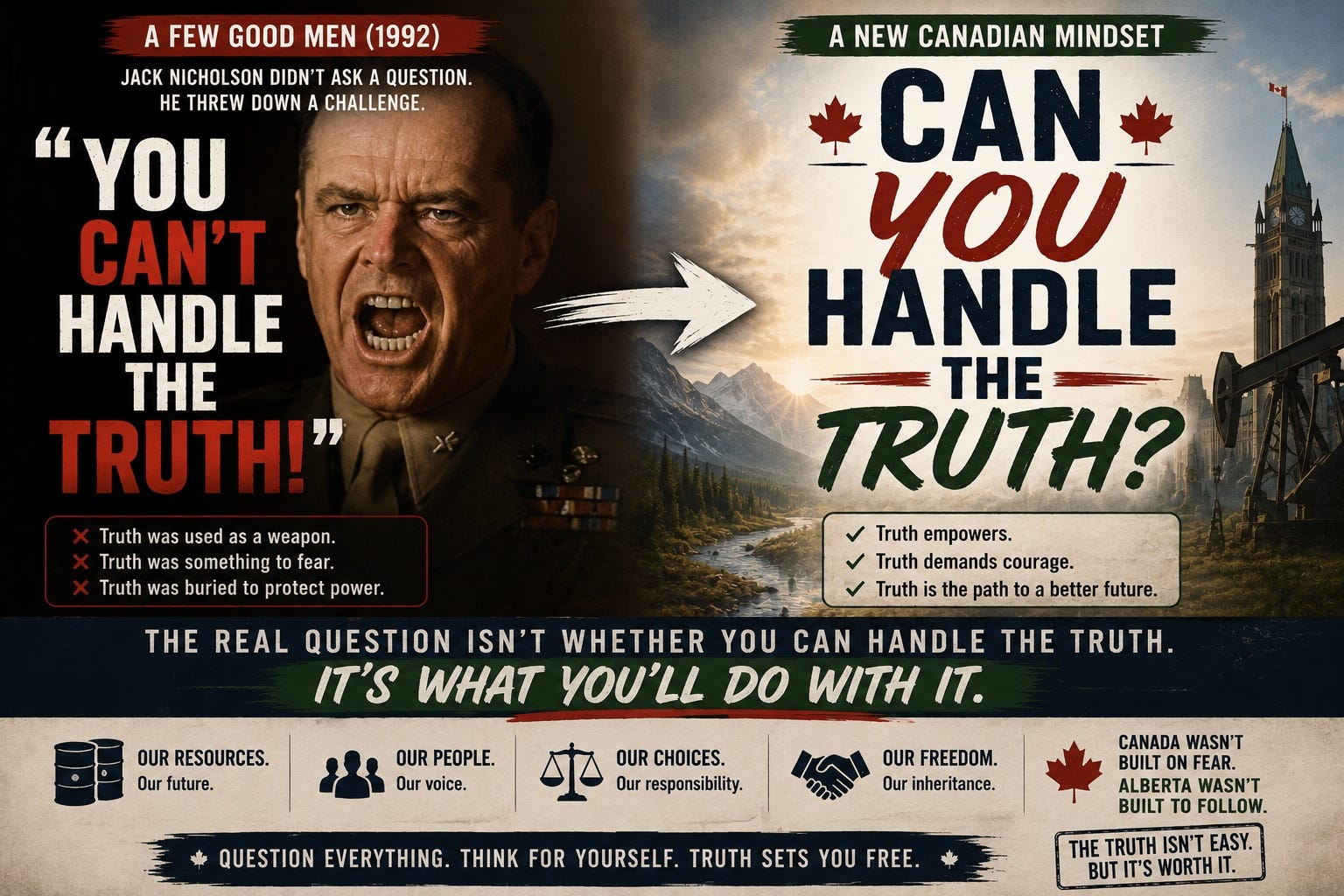
A video has been circulating across Alberta arguing that support for sovereignty is growing because generation after generation of Albertans tried to “fix Canada first” and eventually realized the system itself may not be fixable.

(Click image above to hear the entire post).
Parts of that argument are absolutely true.
Alberta did not enter Confederation on equal footing in 1905. Ottawa retained control over Alberta’s natural resources until 1930. The discovery of Leduc oil in 1947 launched Alberta’s modern energy boom, and the later development of the oil sands transformed Alberta into one of the most strategically important energy regions on Earth. The National Energy Program devastated trust between Alberta and Ottawa. Meech Lake failed. Charlottetown failed. Western alienation is real.
But if we are finally going to have an honest conversation about Alberta, sovereignty, and the future of this country, then we need to stop selectively editing history to fit political narratives.
Because the story is much bigger than “Ottawa versus Alberta.”
The post frames Alberta’s frustrations almost entirely as a battle between Alberta and the federal Liberal establishment while quietly omitting the role Conservative governments also played in integrating Canada into international governance structures, foreign investment systems, and global economic frameworks.
That omission matters!
Stephen Harper did not sign the Paris Agreement. Justin Trudeau did. Facts matter, and if we are going to criticize political propaganda, we cannot create our own. But what many Albertans do not realize is that Harper’s government still submitted Canada’s pre-Paris 2030 emissions target before leaving office, and Canada formally adopted the United Nations Agenda 2030 framework in September 2015 while Harper was still Prime Minister.
That should force people to pause and think.
Because if the argument is that Canada has gradually been folded into international climate and governance systems, then honesty requires acknowledging this process did not suddenly begin under Trudeau. The branding changed. The rhetoric changed. The speed increased. But the machinery itself was already moving.
And perhaps no Canadian figure symbolizes this contradiction more than Maurice Strong.
Most younger Canadians have no idea who he was, yet Maurice Strong may be one of the most influential Canadians in modern global governance history. Although born in Manitoba, Strong built much of his career through Alberta’s oil and energy world before becoming one of the most influential architects of modern global environmental governance. He played central roles in the 1972 Stockholm Conference, the creation of the United Nations Environment Programme (UNEP), the 1992 Rio Earth Summit, and the early foundations of what later evolved into Agenda 21 and Agenda 2030. Think about that carefully for a moment. One of the key architects of the global “sustainable development” movement emerged directly from Canada’s oil and energy sector itself. That reality alone challenges the simplistic narrative Canadians have been fed for decades … that oil producers and global environmental governance existed as completely separate or opposing worlds. In many cases, the same elite political, financial, corporate, and policy networks overlapped behind both sides of the public debate. Think about that carefully.
The deeper reality is that many of the same elite financial, political, corporate, and policy circles have long overlapped through international organizations, banking systems, climate forums, investment networks, and transnational governance groups. Organizations like the World Economic Forum, the Trilateral Commission, and other international policy forums are not secret societies controlling the world from smoke-filled rooms, as some claim. But they do represent networks where politicians, bankers, CEOs, academics, and policy leaders gather to shape global economic and governance directions largely outside public visibility.
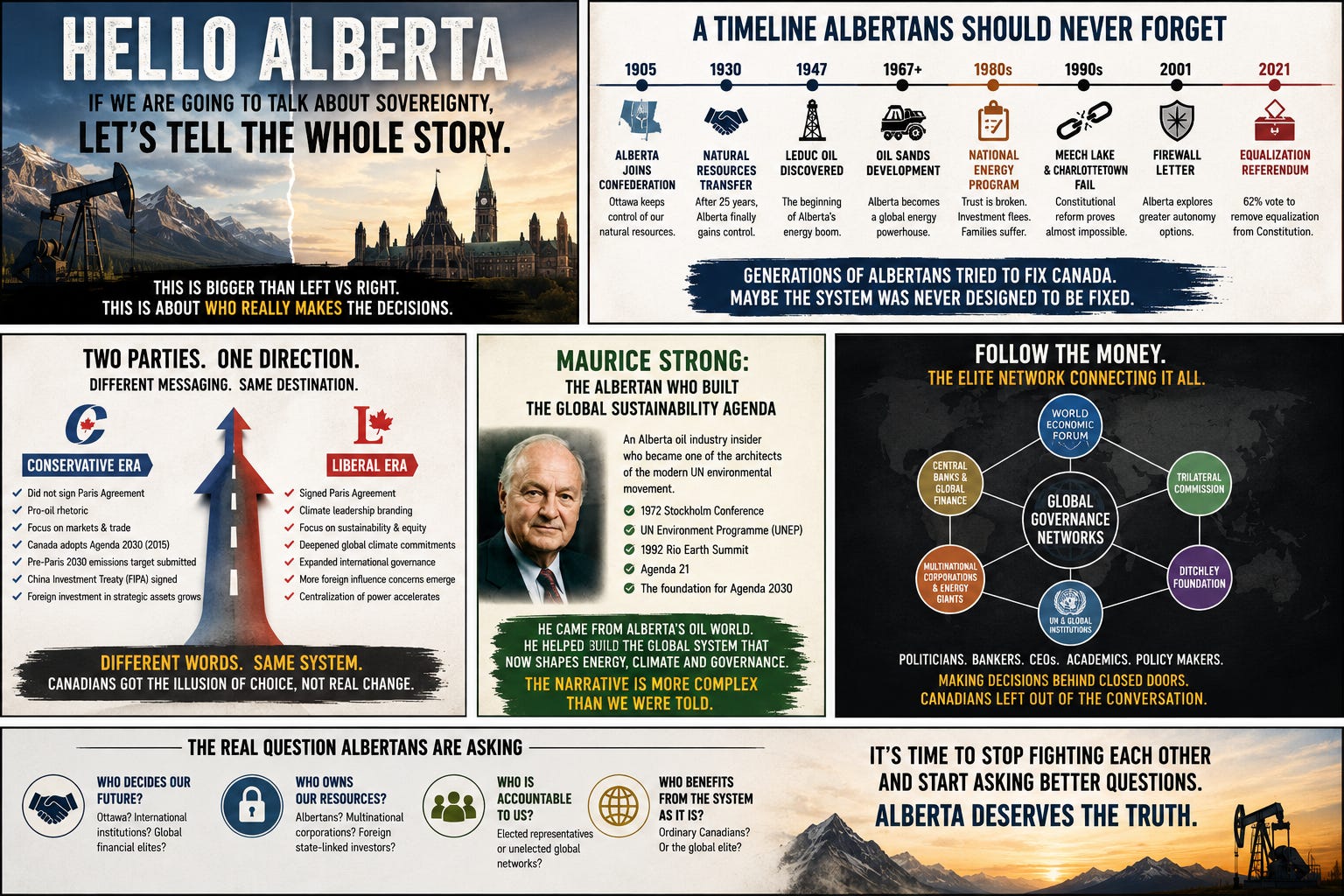
And many Canadians are beginning to realize they never had much democratic input into those directions.
The contradictions become even more obvious when examining Alberta’s oil sands themselves.
Albertans are often told Ottawa is the primary threat to Alberta sovereignty. Yet for decades governments of all political stripes actively encouraged multinational finance and foreign investment into Alberta’s strategic energy sector. Chinese state-linked companies acquired major positions in Canadian energy assets. Under Harper, Canada signed the Canada–China Foreign Investment Promotion and Protection Agreement, granting significant legal protections to Chinese investments operating in Canada. At the same time Canadians were assured globalization would only bring prosperity.
Years later, concerns surrounding foreign influence operations, Chinese “service stations,” and military exchange programs involving Chinese personnel training in Canada suddenly entered public debate, leaving many Canadians asking a reasonable question: were sovereignty concerns ignored for decades in pursuit of global economic integration?
And now we enter the Mark Carney era.
Carney does not represent traditional politics in the way Canadians once understood it. He represents the growing fusion of global finance, climate policy, banking systems, ESG frameworks, investment governance, and economic management through financial institutions rather than direct democratic debate.
This is why many Albertans increasingly feel politically homeless.
Because the deeper people dig, the harder it becomes to believe this was ever simply a battle between Liberals and Conservatives. Both sides often moved Canada further into international governance frameworks, global financial systems, and centralized administrative structures … they simply marketed it differently.
Liberals sold it through the language of sustainability, equity, climate leadership, and global citizenship.
Conservatives sold it through trade, markets, competitiveness, investment, and economic growth.
But the direction of travel often remained remarkably similar.
That is the conversation Alberta needs to have.
Not emotional slogans.
Not partisan tribalism.
Not selective history….Truth.