


Click image above for full article and video
Walk into a grocery store today and you might notice something that would have seemed absurd just a few years ago: gates at the entrance, cameras tracking movement, and in some cases, meat wrapped in anti-theft devices like it’s a high-end electronic. The explanation is always the same, rising theft, organized retail crime, the need to protect staff and inventory. And to be fair, those issues are real. Stores are responding to losses, and on the surface, these measures make sense.
But step back for a moment and look at the pattern instead of the individual pieces.
Because something is changing, not just in how products are protected, but in how people move through a space that was once open and unremarkable. Grocery shopping used to be one of the most ordinary, frictionless parts of daily life. You walked in, picked what you needed, and left. No barriers. No permissions. No second thought.
Now there are gates.
And that shift matters more than most people realize. If this were only about theft, the controls would stay where the theft happens, at the shelf, at the checkout, at the exit. But when you place a gate at the entrance, you’re not just protecting products anymore. You’re controlling access. You’re deciding how and when people are allowed to enter a space where essential goods are sold.
That’s not a conspiracy theory. That’s an observable change in function.
This is where the word “conditioning” comes in … not as a dramatic accusation, but as a simple description of how systems evolve. Conditioning doesn’t require a master plan or a coordinated agenda. It happens gradually, through a series of small, reasonable changes that people accept one at a time. Each step is justified. Each step feels temporary. Each step solves a problem.
Until it becomes permanent. And this is not a new concept.
Jean-Claude Juncker once described how large-scale change is often introduced:
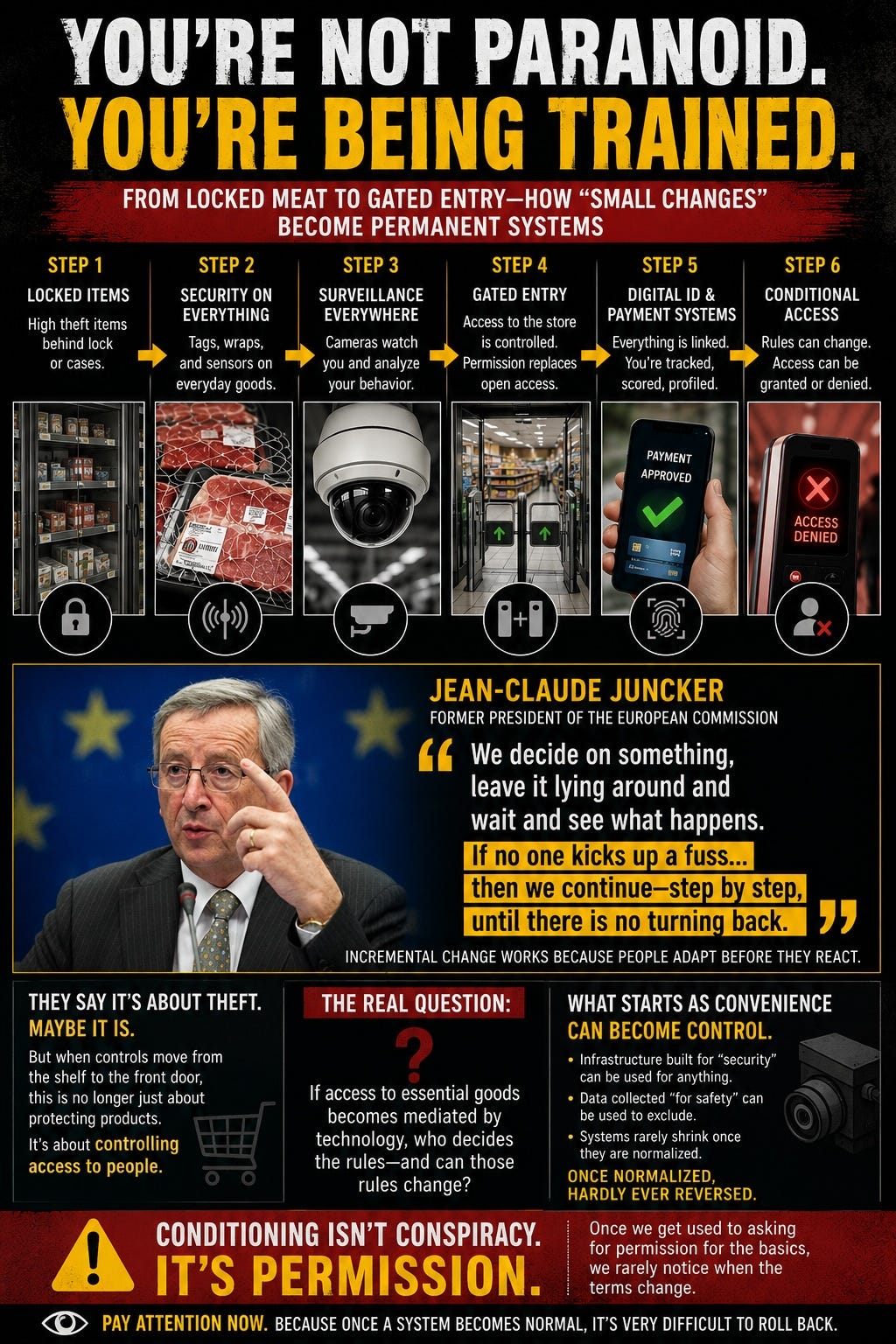
“We decide on something, leave it lying around and wait and see what happens. If no one kicks up a fuss… then we continue—step by step, until there is no turning back.”
Whether you agree with his politics or not, the principle he described is unmistakable:
incremental change works because people adapt before they react.
Look again at what’s happening in our stores.
First it’s locked cabinets for high-theft items. Then it’s security tags on everyday goods. Then it’s gates at the entrance. Then it’s cameras that don’t just record, but analyze. None of these changes, on their own, signal something extreme. But together, they begin to reshape expectations.
What used to feel intrusive starts to feel normal. And that’s the point where people stop asking questions.
Right now, no one in Canada is being denied a steak because of a personal “score.” That’s not happening. But the infrastructure being put in place … controlled entry, surveillance, digital transactions, data tracking, raises a more important question that almost no one is asking out loud:
If access to essential goods becomes mediated by technology, who decides the rules, and can those rules change?
Because systems rarely stay limited to their original purpose. A gate installed for “flow control” can just as easily become a gate that requires validation. A camera installed for “security” can evolve into a system that categorizes behavior. A payment system designed for convenience can become a point of control.
Not because that was the original intent (it’s always introduced as “for your protection”), but because the capability exists.
History shows us that once infrastructure is built, it tends to expand, not shrink.
And this is where people get dismissed too quickly. The conversation gets shut down with labels: alarmist, paranoid, “tin foil hat.” But noticing patterns is not paranoia. It’s awareness. The real question isn’t whether every fear will materialize exactly as imagined. The question is whether we are paying attention early enough to shape the outcome. Because once a system becomes normalized, it becomes very difficult to roll back.
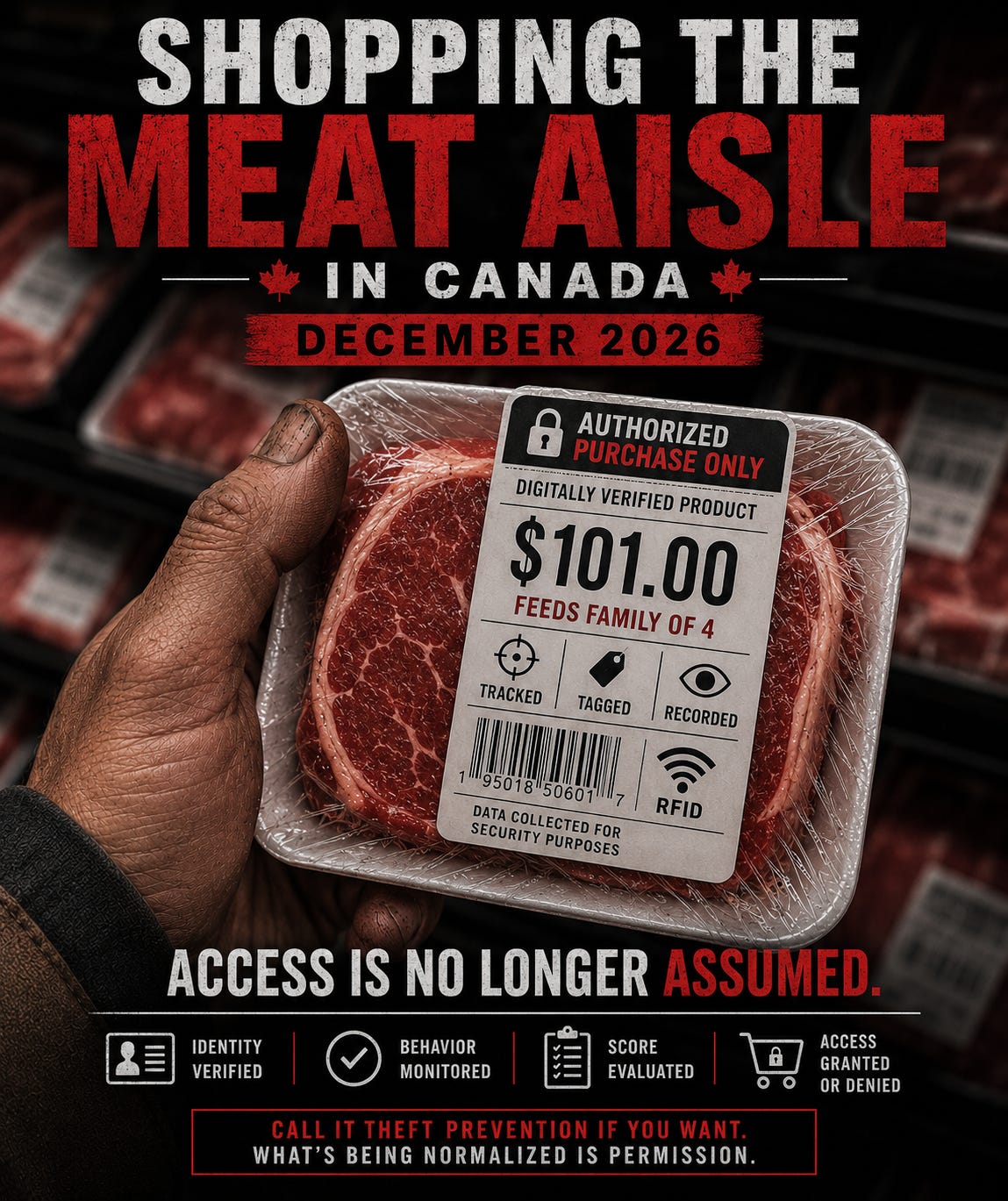
The image of meat wrapped in anti-theft wire might seem like a small thing. A temporary response to a temporary problem. But culturally, it signals a shift in how access to basic goods is managed. It introduces friction where there used to be none. It introduces oversight where there used to be trust. And most importantly, it introduces the idea … quietly … that access can be controlled.
Call it theft prevention if you want. That may very well be how it started. But what’s being normalized is something else entirely:
Permission.
And once people get used to asking for permission for the basics, they rarely notice when the terms change.
What Can I Do?
Start where you are. You don’t need a movement, and you don’t need permission, you just need to stop sleepwalking through the changes happening around you. When you notice new gates, locked sections, or increased surveillance in your local stores, don’t just walk past it. Ask questions. Speak to staff politely and find out what’s changed and why. Awareness is where this begins, and simple conversations are often enough to make others start noticing too.
Ask for transparency. Reach out to store managers, corporate offices, or even your local representatives and ask direct, reasonable questions: What data is being collected? Is facial recognition being used? Could access to goods ever be restricted? You may not always get clear answers, but asking the questions puts these concerns on record and that matters.
Support alternatives wherever you can. Every dollar you spend is a vote for the kind of system you want to live in. Local farmers, independent butchers, and community markets still operate largely outside these centralized systems. The more people support them, the harder it becomes for any one system to control how food is accessed. Keep some independence in your own life. This doesn’t mean panic or extremes … it means being practical. A stocked freezer, a connection to local suppliers, and reducing reliance on a single system all build resilience. And resilience is not fear … it’s freedom.
Talk about what you’re seeing, but keep it grounded. You don’t need to convince anyone of a worst-case scenario. Just ask simple questions that make people think: “Have you noticed how much grocery stores are changing lately?” That’s often enough to open the door.
And most importantly, don’t normalize everything. Not every “security measure” is harmless, and convenience should never come at the cost of unquestioned control over basic access. If something feels off, pause before accepting it as just the new normal.
Because systems like this aren’t stopped after they’re fully built. They’re stopped while people still believe they’re harmless.
I've read 'Creature From Jekyll Island' by Edward G Griffin and the 'one world government' with a 'one world military' where you will own nothing inside a controlled city is outlined by this book as being planned long ago. From CFR (Council on Foreign Relations), Club of Rome, Bilderberg, Maurice Strong, Rockefellers, Morgans, private world bankers you can read from their words what's being implemented today. A Fabian plan for reduced population, to a monetary system that monetizes every living, non living thing to back a world currency. All that you see today is in lockstep with the 'New World Order". And it's being done to all of us with the help from sheeple like the 'elbows up' crowd that vote for their own prison.
When the covid experiment came to town, at the local superstore, I noticed that the front display of goods by the entrance was removed. Hmmmm....that could only mean theft was up. Masks were enouraged/allowed....that means theft would go up across the board everywhere. After that a couple years later, there was a whole aisle that now carried south Asian/Indian products.....hmmm...that could only mean there was a whole new demographic moving in. I wonder how they knew that....it was like magic. Step by step by step....or as Mr. Icke would say, 'the totalitarian tip toe'. And in a short few years, every element of your once high trust society was gone....Poof, The Magic Dragon.