

What If We’ve All Been Played?
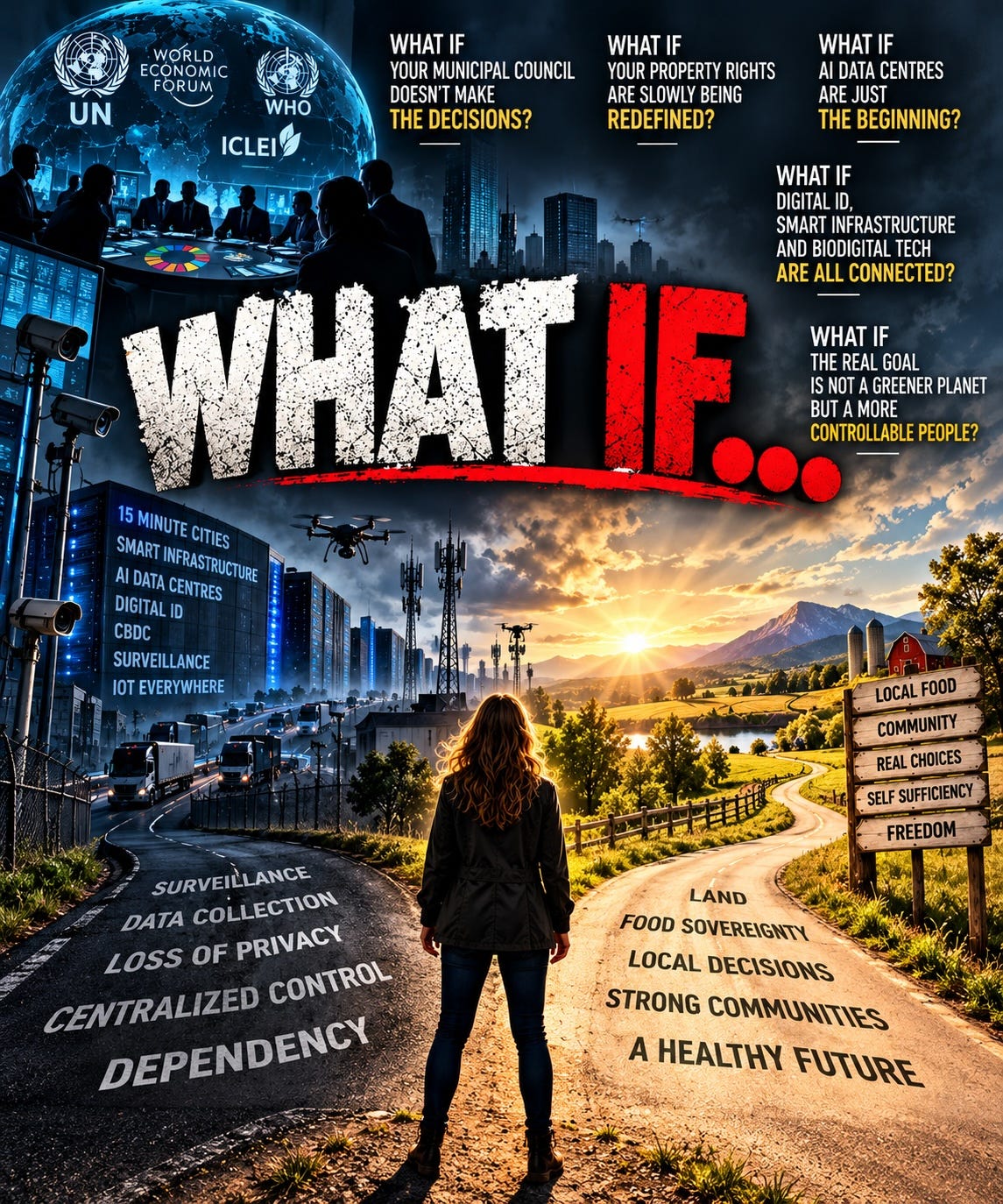
I am going to ask you to do something that may make you uncomfortable.
Put down your political flag for a few minutes.
Set aside the labels. Left. Right. Woke. Conservative. Liberal. Environmentalist. Freedom fighter. Indigenous activist. 2SLGBTQI+ advocate.
Forget who you voted for.
Forget who you have been told to hate.
And ask yourself one question.
What if the causes we have spent decades fighting over are distracting us from decisions being made about the future of humanity itself?
I am not asking you to abandon your beliefs.
I am asking you to examine who benefits from them, who funds the organizations that claim to represent them, and who ultimately gains power from the policies implemented in their name.
Because I believe we are in a struggle far more consequential than another election, another protest, or another political argument.
It is a struggle over human sovereignty.
Over our land, our food, our water, our energy, our money, our bodies, and increasingly, our biological identity. And while we fight one another, an extraordinary transformation of society is underway.
Two things can be true at the same time.
You can believe passionately in a cause and still be manipulated by those claiming to champion it.
You can support environmental protection and question the policies being sold as sustainability.
You can defend minority rights and question the political organizations claiming to speak for entire communities.
You can believe in reconciliation and question whether government programs genuinely advance Indigenous self-determination.
You can embrace technological innovation and reject a future in which technology becomes a means of controlling human beings.
These are not contradictions.
They are the foundations of critical thinking.
This Did Not Begin Yesterday
In 1972, the Club of Rome commissioned The Limits to Growth, a study examining population, industrial growth, resource depletion, food production, and pollution.
In 1991, the Club of Rome published The First Global Revolution, discussing global threats, environmental challenges, and the need for international cooperation.
In 1992, the United Nations adopted Agenda 21 at the Earth Summit in Rio de Janeiro.
Agenda 21 addressed population dynamics, human settlements, agriculture, land management, environmental protection, education, and the roles of governments and community organizations.
In 1994 Agenda 21 Moves Into Municipal Government
Just two years after the Rio Earth Summit, Canada had a municipal implementation guide. Dated January 26, 1994, A Municipal Primer on the United Nations Conference on Environment and Development was prepared for the Federation of Canadian Municipalities and the Canadian Council of Ministers of the Environment.
The primer was reportedly circulated to municipalities across Canada, providing guidance on bringing sustainable development into local strategic planning.
And Canada was not alone.
In 1994, Australia and New Zealand published local-government sustainability guides. European municipalities adopted the Aalborg Charter, launching a coordinated sustainable-cities initiative. The United Kingdom, Finland, and other countries were also developing municipal Agenda 21 processes.
By 1996, an international planning guide published by ICLEI, Canada’s International Development Research Centre, and the United Nations Environment Programme documented Local Agenda 21 initiatives across numerous countries.
Think about that. Agenda 21 was not simply a document sitting on a shelf at the United Nations. Within a few years, international objectives were being translated into planning methods for municipalities around the world.
And that raises a question every man and woman should be asking:
How many people understood that their local municipal policies were increasingly being developed within an international sustainable-development framework?
Then, in 2015, came Agenda 2030. Seventeen Sustainable Development Goals. One hundred and sixty-nine targets.
Poverty.
Hunger.
Health. Education.
Gender equality.
Energy. Infrastructure.
Cities.
Consumption.
Climate.
Institutions.
Partnerships.
Read those categories again.
They touch almost every major aspect of organized human life.
Of course, protecting the environment, reducing poverty, and improving health are worthwhile goals.
But:
who decides how those goals are achieved?
Who measures compliance?
Who pays?
Who profits?
And who can say no?
The UN presents Agenda 2030 as a voluntary international framework. Its text does not establish a mandate to eliminate 90% of humanity. Nevertheless, the history of population policy, environmental governance, and technological development deserves rigorous public examination.
My concern is not simply what these documents promise.
It is what governments and institutions may build in their name.
The Canadian Government Has Published the Connections…
You do not have to take my word for it.
Go to the Government of Canada’s website.
Read its Federal Implementation Plan for the 2030 Agenda.
The government identifies responsibilities across federal departments, establishes reporting structures, incorporates Sustainable Development Goals into policy development, and provides funding for projects intended to advance those goals.
It calls for participation across society. Think about what that means…
Environmental organizations.
Indigenous organizations.
Women’s organizations.
2SLGBTQI+ organizations.
Universities.
Businesses.
Municipal governments.
Community groups.
Each may participate for entirely sincere reasons. But they can also become part of a common policy framework without their members fully understanding how that framework operates.
When does financial support become institutional dependency?
When does consultation become an exercise in securing agreement with decisions already made?
When does a community organization stop representing its members and begin representing the priorities of its funders?
These are questions we should be asking regardless of our politics.
Follow the Money: When Funding Becomes a Mechanism of Control
There is something I want every reader to consider, regardless of which cause they support.
Every movement needs resources.
Environmental organizations need funding. Indigenous organizations need funding. Community associations, universities, charities, advocacy groups, agricultural organizations, and social initiatives all need funding.
And increasingly, that funding comes from governments, major corporations, financial institutions, and philanthropic foundations.
But money is rarely distributed without conditions.
Funding programs have priorities. Grant applications have eligibility criteria. Corporate sponsors have policies. Government departments have strategic objectives. Sometimes these conditions are entirely reasonable. Public money should come with accountability.
But there is another question we should be asking.
At what point does funding stop supporting a cause and start directing it?
What happens when an organization must demonstrate alignment with a funder’s priorities to qualify for financial support?
What happens when the people administering a program privately disagree with its requirements?
What happens when an organization fears that challenging a policy might jeopardize its next grant?
And what happens when the people who depend on that organization are never told about those pressures?
No threats are necessary. No explicit censorship is required.
Sometimes the possibility of losing funding is enough to encourage silence.
Consider how this could operate across society.
An environmental organization may find it easier to secure funding for approved sustainability initiatives than for challenging politically favoured industrial projects.
An agricultural association may face incentives to promote particular technologies or reporting systems.
A community organization may be encouraged to adopt institutional language or policies that do not reflect the views of all its members.
A university researcher may find certain projects easier to finance than others.
A municipality may discover that access to infrastructure funding depends on satisfying priorities established far beyond its own council chambers.
These are possibilities worth investigating, not conclusions about every organization receiving a grant. But the underlying question remains the same.
Who is setting the agenda, the people an organization claims to represent, or the institutions financing its activities?
Now examine Canada’s implementation of Agenda 2030.
The federal government openly describes partnerships with civil society, businesses, Indigenous organizations, educational institutions, and other levels of government.
It also provides funding intended to advance Sustainable Development Goals. Those relationships are not hidden. The question is how they influence decisions.
Are organizations free to challenge the policies attached to the funding?
Are alternative approaches considered fairly?
Can communities reject initiatives without financial consequences?
And can ordinary citizens trace where the money originates, what conditions accompany it, and how success is measured?
This is where the concept of regulatory capture becomes especially important. Regulatory capture occurs when institutions responsible for protecting the public interest become unduly influenced by the interests they are supposed to oversee.
Financial dependency can create related risks of institutional capture, even outside formal regulatory bodies.
And perhaps the most important question is one we rarely ask:
If the funding disappeared tomorrow, would the organization still be promoting exactly the same priorities?
That question is not an accusation. It is an invitation to think. Because genuine independence is not measured by the words in an organization’s mission statement. It is measured by its ability to disagree with those who hold the purse strings.

***To My Environmentalist Friends: Explain the AI Data Centre Contradiction***
You have spent decades fighting to protect our planet. You have marched against pollution, defended forests, protected wildlife, and demanded that governments reduce emissions. You have been told we face an existential climate emergency.
We must achieve net zero.
We must reduce consumption.
We must change how we travel, heat our homes, produce food, and use energy.
Now look at what is happening.
Governments are welcoming enormous AI data centres. These facilities require extraordinary amounts of electricity, substantial infrastructure, and, depending on their cooling systems, significant water resources. The International Energy Agency projects that global data-centre electricity consumption will approximately double between 2025 and 2030. AI-focused facilities are expected to grow even faster.
So here is my question.
How can we be in such an urgent energy and climate crisis that ordinary people must fundamentally change their lives, while governments simultaneously encourage massive new industrial electricity demand?
Perhaps some AI applications will produce environmental benefits. That possibility deserves examination too. But:
Where is the full accounting?
Who supplies the electricity?
Who pays for grid expansion?
What happens to farmland, wetlands, water resources, and wildlife habitat?
Why should the public accept sacrifices without demanding equally rigorous scrutiny of corporate expansion?
If you truly care about the environment, these questions belong at the centre of your movement.
Not on the sidelines.
*** To the 2SLGBTQI+ Community: Your Humanity Is Not a Government Program***
I want to make something absolutely clear. Every human being deserves dignity, safety, privacy, and freedom from discrimination.
That should never have been a partisan question.
But consider how government funding, corporate sponsorship, and increasingly polarized political campaigns can affect organizations claiming to represent diverse communities.
The Government of Canada operates a 2SLGBTQI+ Secretariat, supports community organizations, and promotes federal action plans.
Those activities are publicly documented.
But:
Who decides which organizations receive funding?
What policy objectives are attached?
Can an organization openly disagree with government priorities without jeopardizing its relationship with funders?
And what happens to people within a community who do not agree with the positions taken by its most prominent organizations?
People who once stood together can now find themselves divided over questions of identity, language, medical ethics, parental rights, and freedom of expression.
Not every 2SLGBTQI+ person thinks alike. Not every organization speaks for the people whose initials it uses. And that is precisely the point.
When did defending individual freedom begin to require unquestioning agreement with an organization’s entire political agenda? When funding depends on promoting particular policies, can organizations remain genuinely independent?
Who decides which voices are amplified and which are excluded? And who benefits when people who should be defending one another’s fundamental liberties are encouraged to fight among themselves?
You do not have to abandon your identity, your community, or your principles to question the institutions that claim to represent you.
Quite the opposite. Your identity belongs to you. It does not belong to a political party, a government department, or a grant-funded organization.
No community should have to surrender independent thought in exchange for recognition or support.
*** To Indigenous Peoples and Their Allies: Who Controls the Land?***
Reconciliation. Sovereignty. Consultation. Self-determination.
These are powerful words.
Canada has adopted legislation intended to advance implementation of the United Nations Declaration on the Rights of Indigenous Peoples.
Meanwhile, major infrastructure, energy, mining, and technology projects continue to raise questions about land, resources, consultation, and consent. Those questions are not all the same, and Indigenous nations do not all share the same priorities.
But the principle is straightforward.
Who has meaningful authority over the decisions that affect a community’s land, water, resources, and future?
And while Indigenous and non-Indigenous Canadians argue over their differences, are we paying enough attention to the corporations, government departments, and administrative institutions making consequential decisions?
Historical injustices must not be erased. Neither should they prevent us from recognizing present-day interests we share.
Our children will inherit the same land, the same water systems, and many of the same technological dependencies. Surely that gives us reason to talk to one another rather than remain permanently divided.
***To the Farmers, Rural Communities, and Food Sovereignty Advocates***
You are told that agriculture must become more sustainable, more efficient, more measurable, and more technologically advanced. Increasingly, those promises involve connected equipment, sensors, automated systems, digital reporting, and data-driven management.
Some of these tools genuinely help farmers.
Others raise important questions about ownership, cost, privacy, repair rights, and dependence on technology providers.
Who owns the agricultural data?
Who controls the software?
Can farmers continue operating independently?
Can a family farm compete if compliance increasingly requires expensive technology?
And who determines what sustainable agriculture actually means?
Food sovereignty means very little if those producing our food lose meaningful control over how they produce it.
The Next Frontier Is Not Just Digital. It Is Biological.
Now we arrive at the subject I believe deserves the attention of every human being.
In 2020, Policy Horizons Canada published a report titled Exploring Biodigital Convergence: What Happens When Biology and Digital Technology Merge?
This is a Government of Canada publication. It examines the merging of biological and digital technologies. The report discusses developments that could change human bodies, minds, and behaviours, alter genomes, create new biological-digital systems, and challenge conventional understandings of what is human.
The report is foresight research, not a declaration that the government intends to impose these outcomes. But that does not make the questions any less profound.
Who is developing these technologies?
Who owns the patents?
Who controls the data?
Who establishes the ethical boundaries?
What happens when artificial intelligence, biological engineering, digital identification, and increasingly connected infrastructure begin to intersect?
Will participation remain voluntary?
Will meaningful informed consent be protected?
Will people retain the right to refuse technological interventions without losing access to essential services?
And perhaps most importantly:
Who has the authority to redefine what it means to be human?
I believe the public has been given nowhere near enough opportunity to debate these questions.
Technological capability must never be confused with moral authority.
Just because something can be engineered does not mean humanity has consented to it.
Follow the Funding. Follow the Policy. Follow the Power.
There is a concept every man, woman and child should understand.
Regulatory capture.
It describes circumstances in which institutions intended to serve the public become unduly influenced by the industries or interests they are supposed to regulate.
Now broaden the investigation.
Examine government grants.
Examine corporate sponsorships.
Examine advisory committees.
Examine international partnerships.
Examine the movement of people between government, industry, and nonprofit organizations.
Examine the language used in policy documents and funding agreements.
Ask whether organizations are rewarded for achieving independently chosen community goals or for advancing priorities established elsewhere.
Funding alone does not establish corruption or control. But neither should a noble mission statement exempt an organization from scrutiny.
The same standards must apply to environmental groups, Indigenous organizations, social justice advocates, agricultural associations, corporations, and conservative organizations.
The question is not whether we like the cause. The question is whether the institutions serving that cause remain accountable to the people.
Division Is a Gift to Concentrated Power
Look at what we have become.
Left against Right.
Environmentalists against farmers.
Urban against rural.
Indigenous against non-Indigenous.
Religious against secular.
Parents against teachers.
One generation against another.
Neighbor against neighbor
vax against unvax
We have been encouraged to define ourselves by what separates us.
Political division can arise from genuine differences, but it can also be exploited by institutions seeking influence. And while we fight over labels, questions about infrastructure, data ownership, regulatory authority, and technological governance receive far less public attention.
Ask yourself:
Who benefits when neighbours stop speaking?
Who benefits when disagreement becomes hatred?
Who benefits when citizens are too busy fighting one another to scrutinize those exercising power?
I am not asking you to abandon your cause. I am asking you to consider whether defending that cause has prevented you from seeing the larger picture.
What if the person you have been taught to fear is the very person whose cooperation you need to protect your freedom?
The Struggle for Humanity’s Future
I have serious concerns about the direction of technological and institutional development.
I am concerned about population governance, the concentration of economic power, biological engineering, surveillance, and the possibility of a future in which human autonomy becomes conditional on participation in interconnected systems.
I believe the warnings deserve attention now, not after the infrastructure is irreversible. I also believe that claims about deliberate depopulation, including the often-repeated 90% figure, must be investigated with evidence rather than simply accepted or dismissed.
The stakes are too high for careless conclusions.
But we do not need to prove a single secret master plan before defending the principles that matter.
Bodily autonomy.
Informed consent.
Freedom of expression.
Local self-government.
Privacy.
Food sovereignty.
Property rights.
Accountable institutions.
The right to remain fully human without being compelled to accept technological modification.
These are not exclusively Left-wing or Right-wing values.
They are principles people across political traditions can defend together.
It Is the Eleventh Hour
I am asking you to stop pretending that everything is fine simply because the policies carry reassuring names.
Sustainable.
Inclusive.
Smart.
Resilient.
Equitable.
Innovative.
Those words are not substitutes for evidence, consent, or accountability.
Ask what a program actually does.
Ask who benefits.
Ask who loses authority.
Ask whether the public can reject it.
Ask what happens when the funding ends.
Ask whether the systems being constructed will expand human freedom or make people increasingly dependent on institutions they cannot meaningfully challenge.
And if you already see troubling contradictions but remain silent because speaking up could cost you friends, influence, funding, or acceptance, I ask you to reconsider.
When did belonging to a political tribe become more important than defending our shared humanity?
We do not have to agree about climate science, religion, gender, public health, or every historical injustice to stand together against coercion and unaccountable power.
We can disagree and still defend one another’s rights.
We can question institutions without attacking the people those institutions claim to serve.
We can demand evidence without surrendering our moral convictions.
We can refuse to be divided without pretending our differences do not exist.
This Is My Call to Every Side
To the environmentalist: Bring your commitment to protecting nature.
To the Indigenous rights defender: Bring your commitment to sovereignty and self-determination.
To the 2SLGBTQI+ advocate: Bring your commitment to individual dignity and freedom.
To the farmer: Bring your commitment to food and land.
To the conservative: Bring your commitment to limited, accountable government.
To the progressive: Bring your commitment to challenging concentrated power.
To the parent and grandparent: Bring your determination to leave the next generation a future worth inheriting.
We do not need to become one political movement.
We need to recover our ability to recognize common interests, investigate common threats, and defend common freedoms.
The future of humanity is too important to leave to political parties, corporate boardrooms, international institutions, or algorithms.
The time has come to examine the machinery, question the narratives, demand accountability, and reclaim our right to determine our own future.
Not through hatred.
Not through violence.
Not through another manufactured division.
Through knowledge, courage, public scrutiny, peaceful civic action, and solidarity.
No more pretending we are sleeping.
No more surrendering our judgment to institutions because they use language we happen to agree with.
No more treating our neighbours as enemies while ignoring the decisions that affect us all.
We are human beings first.
And whatever future awaits us, it must be a future humanity freely chooses.
It is time to open our eyes… Together.
Start your own investigation
Don’t take my word for it. Read the original documents, follow the funding, examine what is happening in your municipality, and ask your elected representatives who authorized the decisions affecting your community.
Our disagreements need not disappear. But our willingness to defend one another’s fundamental freedoms must return.
The question is not which side wins.
The question is whether ordinary human beings retain the power to decide what comes next.

… here are some links to get you started
1. The historical foundations: 1972–2015
Club of Rome — The Limits to Growth (1972)
— Examine the original discussions of population, resources, industrialization, and environmental limits.
United Nations — Agenda 21 (1992)
— Read especially Chapter 5 on population dynamics and Chapter 28 on local authorities.
United Nations — Transforming Our World: Agenda 2030 (2015)
— The complete document establishing the 17 Sustainable Development Goals and 169 targets.
2. How international frameworks reached municipalities
Canada’s 1994 Municipal Primer - Reference and historical material
— Information about the municipal primer prepared for FCM and CCME. This is a secondary source; the original document and distribution records should be examined separately.
Local Agenda 21 Planning Guide (1996)
-Published through Canada’s International Development Research Centre, with ICLEI and UNEP involvement. Examine how international sustainability goals were translated into local planning.
Report of Canada to the United Nations Commission on Sustainable Development 1994
3. Canada’s Agenda 2030 implementation
Canada’s Federal Implementation Plan for Agenda 2030
- Federal responsibilities, partnerships, funding, and reporting.
Government of Canada - Agenda 2030
- Canada’s federal SDG programs and implementation resources.
4. Government funding and advocacy organizations
Government of Canada - Grants and Contributions Database
- Search organizations by name to investigate federal funding recipients, amounts, and purposes.
Women and Gender Equality Canada - Free to Be Me
- Explore federal initiatives, funding, and community partnerships.
Justice Canada - UNDRIP Implementation
- Examine Canada’s legislation, action plans, and implementation process.
5. Biodigital convergence and the future of humanity
Policy Horizons Canada - Exploring Biodigital Convergence (2020)
- Examine the government’s discussion of merging biological and digital systems, including technologies that could change human bodies, minds, and behaviours.
Policy Horizons Canada - Biodigital Today and Tomorrow (2022)
- Further examination of emerging technologies and potential societal implications.
6. AI data centres and environmental contradictions
International Energy Agency - Energy and AI
- Research electricity demand, energy infrastructure, and AI expansion.
Canada’s Net-Zero Emissions Accountability Act
- Examine Canada’s legislated emissions commitments.
as usual comprehensive and enlightening. well done connie - thanks for doing the research. and thank you for the links.
Institutional credit creation pumps money through veins of corruption that empower the takeover of individual rights and freedoms. Here is the only way it can be changed... https://librti.com/view-video/liberty-hours