
The British Are Coming ...
How Financial Empire, Not Armies, Took Control of Canada

While headlines focused on Venezuela, something far more consequential was unfolding, and most Canadians missed it. In this Monday Brief, Susan Kokinda lays out why President Trump’s actions were not about regime change at all, but about exposing the financial plumbing that enables narcotics trafficking, mass migration, and offshore laundering. More importantly, she explains why Canada was quietly put on notice. This video is essential viewing before reading what follows…
CLICK IMAGE BELOW

If you watched the video above carefully, one thing should already be clear: this was never about regime change in Venezuela. As Susan Kokinda explains, what unfolded was a form of irregular financial warfare, a targeted strike against the offshore banking systems that launder narcotics money, facilitate human trafficking, and protect those flows behind the façade of a so-called “rules-based international order.”
Venezuela was not the prize. It was a node.
To me the real significance of this briefing lies in what it reveals about Canada.
When Donald Trump repeatedly warns about drugs and illegal immigration coming from the northern border, many dismiss the comments as exaggeration or political theater. But taken in the context Kokinda lays out, those warnings are neither accidental nor rhetorical. Trump is not confusing Canada with Mexico. He is identifying a structural vulnerability.
The northern border is not a people problem. It is a systems problem.
Canada functions as a clean, trusted, compliance-heavy jurisdiction. That reputation is precisely what makes it valuable. Money, people, and product that cannot move directly into the United States can be routed through Canada first, where strong banking credibility, intelligence cooperation, humanitarian language, and regulatory cover help sanitize them along the way. This applies to drug profits, human trafficking, NGO-funded migration pipelines, and asylum laundering alike. Canada is rarely the source. It is the interface.
This is also why Trump does not name Canada loudly or theatrically. Canada is not the enemy. It is also the node. And in financial warfare, you do not bomb nodes, you expose them. Public threats would trigger diplomatic crises and alert the very systems being targeted. Quiet pressure, enforcement tightening, and repeated signaling about drugs and migration routes accomplish far more. Being “put on notice” does not mean being attacked. It means being warned that neutrality is no longer plausible.
To understand how this architecture works, we have to step back from current headlines and look at the model that came before it as Kokinda points out (see link at end of this article). In 2014, an international policy report on Afghanistan introduced a doctrine called Security through Development. The premise was simple but transformative: instead of securing a nation so it could develop, development itself was reclassified as a security function. Economic planning, infrastructure investment, aid, and institutional reform were no longer political choices. They became matters of international security.
Once that shift occurred, sovereignty became conditional. External oversight became justified. Local resistance became destabilization. The report openly acknowledged that Afghanistan produced the vast majority of the world’s opium and that drug production was tolerated under broader security priorities. It even admitted that most aid money flowed right back out through contractors and banks. The drug economy was not dismantled; it was financialized.
This was not a failure of policy. It was a system functioning as designed.
That model did not remain in Afghanistan. It evolved. Over time, opium was replaced by carbon, counter-narcotics by climate risk, stability by net-zero targets, and aid by ESG finance. The language softened, but the structure remained intact. Political decisions were reframed as financial risks. Once that happens, those decisions leave the democratic sphere and enter the regulatory one. Consent becomes optional. Compliance becomes paramount.
This is where Mark Carney emerges as a critical connector … not as a partisan actor, and not as an elected official, but as a systems translator. Carney’s central contribution has been to move political and moral questions out of democratic debate and into financial-risk frameworks governed by central banks, regulators, and compliance regimes. In this architecture, development, climate policy, and social behavior are no longer debated by citizens; they are managed by institutions.
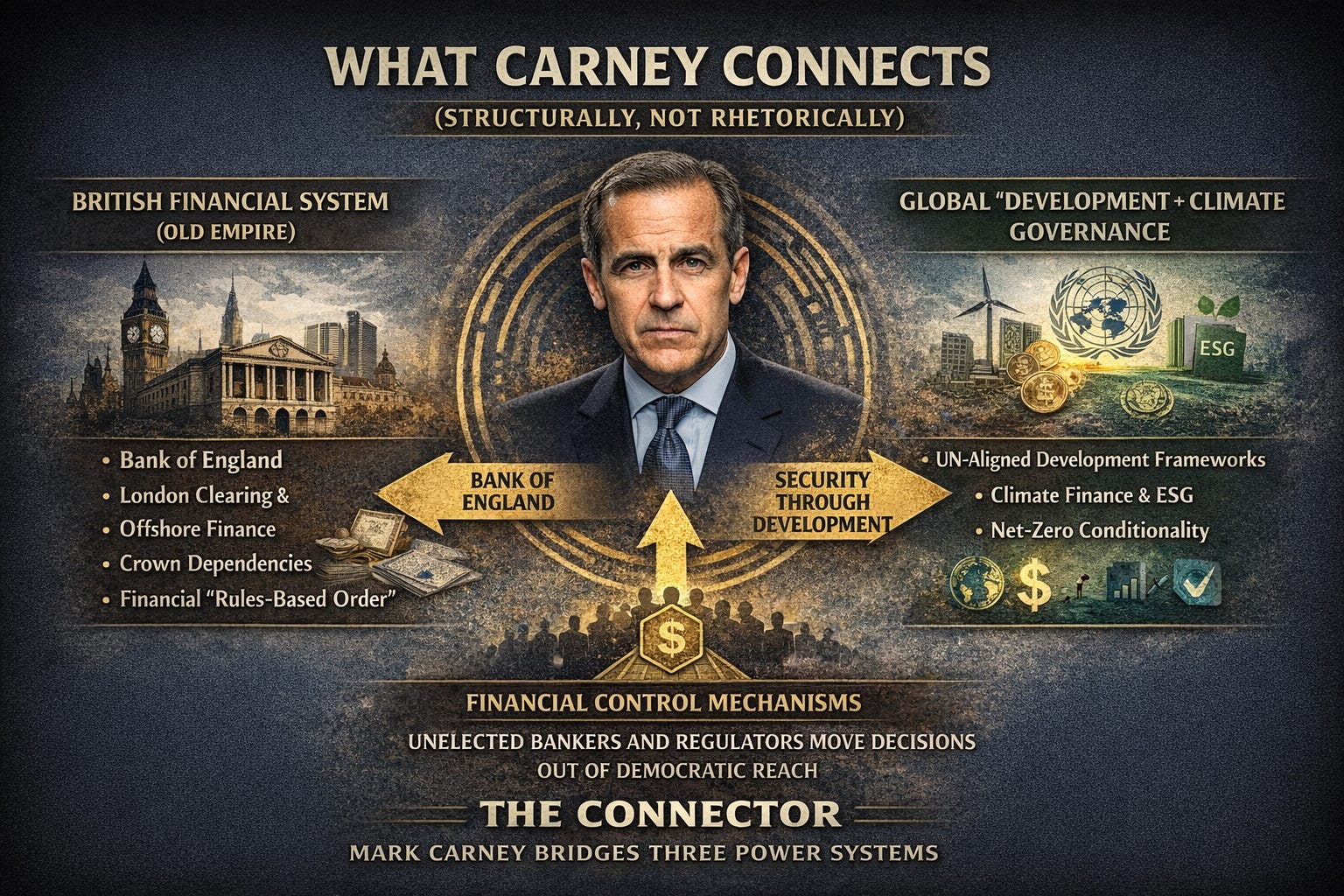
That system depends on predictability. It depends on uninterrupted capital flows. And it depends on domestic quiet.
This is the context in which Canadians must understand the wave of government overreach they have witnessed at home. Emergency powers normalized during COVID were not an aberration. They were a stress test. Governments learned they could suspend civil liberties, freeze bank accounts, criminalize protest, control movement, and enforce narrative discipline … while retaining institutional legitimacy. The rushed bills that followed, whether federal or provincial, did not emerge to govern better. They emerged to remove friction.
These laws are not primarily about safety or efficiency. They are about enforcement. They are written broadly, passed quickly, and grant wide executive discretion because their purpose is to ensure compliance with a system that cannot tolerate disruption, especially from its own citizens.
This is why dissent became intolerable.
Truckers exposed supply-chain fragility.
Farmers exposed food-system control.
Doctors challenged regulatory capture.
Parents challenged education policy.
Citizens challenged financial coercion.
That resistance threatened international commitments Canada had already made; on climate finance, development frameworks, and regulatory alignment without explicit public consent. Silence became necessary.
At this point, the pattern should be unmistakable. The Canadian government did not suddenly “turn authoritarian.” It reclassified its citizens. Canadians were no longer treated primarily as rights-bearing participants in governance, but as risk variables within a managed system. Once citizens are treated as risk, rights become conditional, speech becomes regulated, protest becomes extremism, and Parliament becomes procedural theater.
This is the collision we are now watching. On one side is a system built on development as control, finance as governance, compliance as morality, and silence as stability. On the other is financial exposure, jurisdictional disruption, and an attempt, however imperfect, to attack the plumbing itself.
Venezuela was not the story. Afghanistan was the prototype. Canada is the quiet front.
Trump’s warnings about drugs and immigration from the northern border are not populist noise. They are advance notice. When a country’s greatest strength is being trusted, its greatest vulnerability is exposure.
The British are not coming with armies. They never left!!! They returned through banks, bills, and compliance. And now that architecture is being challenged.
The only remaining question is whether Canadians will continue to look away, or finally ask who authorized this system in the first place.
Because once you see the architecture, you cannot unsee it.
While the focus has been on how global governance frameworks, exemplified by figures like Mark Carney, have shifted political decisions into risk-based institutional oversight, we can see this logic reflected domestically in recent Canadian legislation. Bills such as C-5, C-8, and C-9 expand executive and regulatory authority under the banner of ‘security,’ ‘public safety,’ and ‘risk management,’ often with limited debate or oversight.
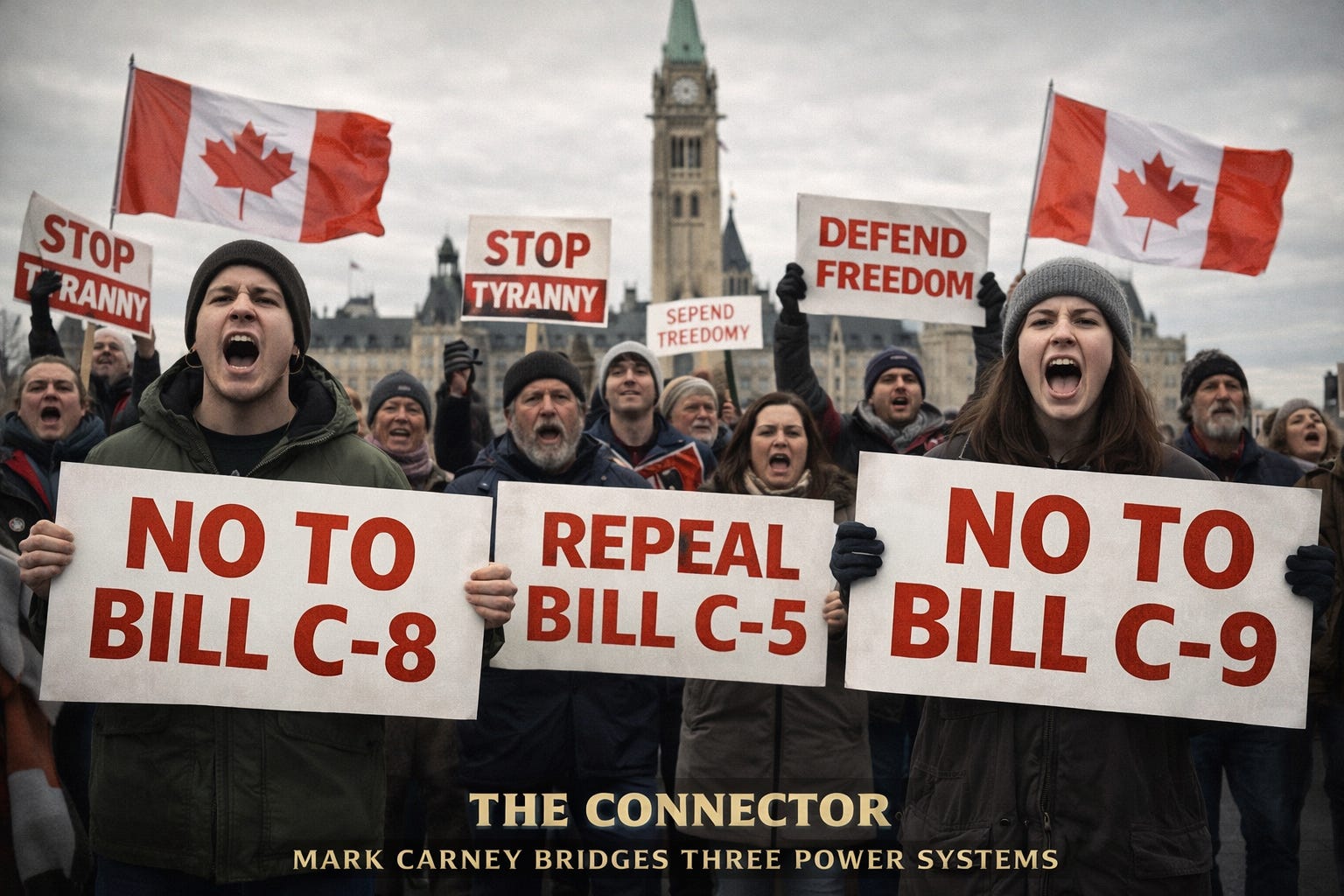
This reflects the same underlying logic: policy outcomes are increasingly governed by administrative discretion and compliance mandates, rather than through broad democratic participation. While these bills do not cite Carney or global financial frameworks by name, they fit within the same governance architecture that prioritizes systemic stability over public consent.
All of this leads to one unavoidable conclusion: awareness without organization changes nothing. Systems this entrenched do not collapse under outrage, nor are they reformed by silence. They persist precisely because people are kept fragmented, overwhelmed, and unsure where to stand. That is why the Army of Concerned Citizens (C3) exists. C3 is not a political party, not a protest group, and not an ideological movement. It is a civic network of informed citizens committed to understanding how power now operates; financially, legally, and institutionally and to restoring the principle that governance requires consent, not compliance. C3 exists to educate, coordinate, and support citizens who refuse to be reduced to “risk variables” in someone else’s model. If this article helped you see the architecture more clearly, then C3 is simply the next step: standing with others who are ready to reclaim their voice, their agency, and their responsibility as citizens. That is what it means to join the Army of Concerned Citizens. CLICK IMAGE BELOW AND SIGN UP

https://www.idmrr.ru/downloads/AlternativeDevelopment-doklad-ENG.pdf
2026 the year the world was saved….
Indeed! Precious, clear, true! Every sentence is a gem!
Unless the entire canadian governmental system is abolished and our inalienable right reinstated as True Sovereign man / woman, the destruction of Canada willl continue...
TIME TO WAKE UP CANADA