
REMEMBER WHEN GREEN MEANT SAVING A TREE?
What Changed?

Remember when we were told forced to go paperless?
Paperless billing.
Paperless banking.
Paperless offices.
Paperless government.
For decades we were told that every piece of paper mattered. Incentives like “get your refund next week by signing up for auto deposit”. “Waive service fees” if you sign up for paperless…..
“Save a tree.” “Reduce your footprint.” “Protect the planet.”
Children were taught that humans were consuming too much, polluting too much, driving too much, eating too much, and expanding too much.
Then suddenly, almost overnight, governments and corporations around the world began promoting one of the largest industrial infrastructure buildouts in modern history:
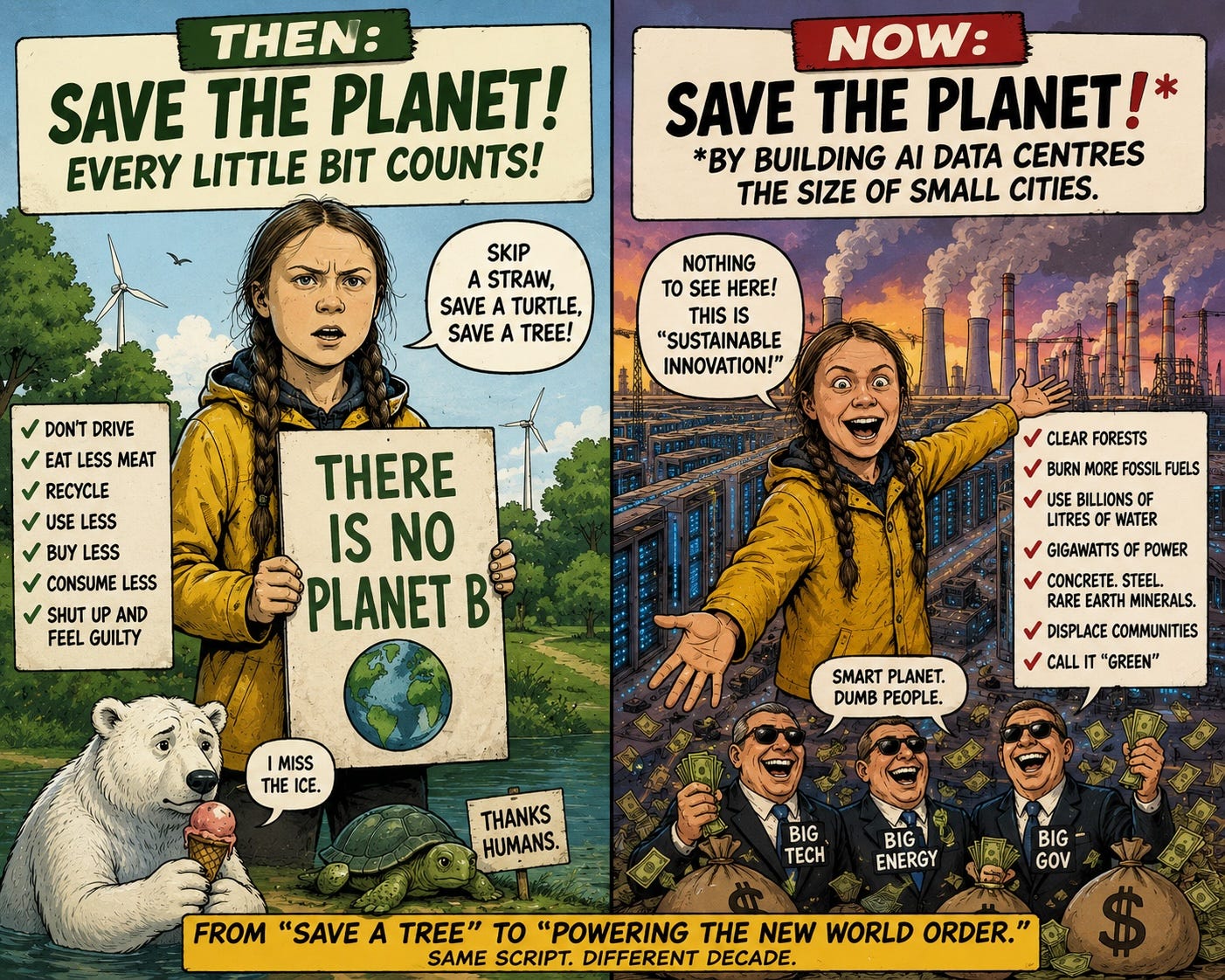
AI data centres.
Massive facilities requiring enormous amounts of:
Electricity
Water
Concrete
Steel
Copper
Rare earth minerals
Transmission infrastructure
Land
Entire forests may be cleared. Massive power generation projects approved. Gigawatts of electricity redirected.
And suddenly the climate alarmists went strangely quiet.
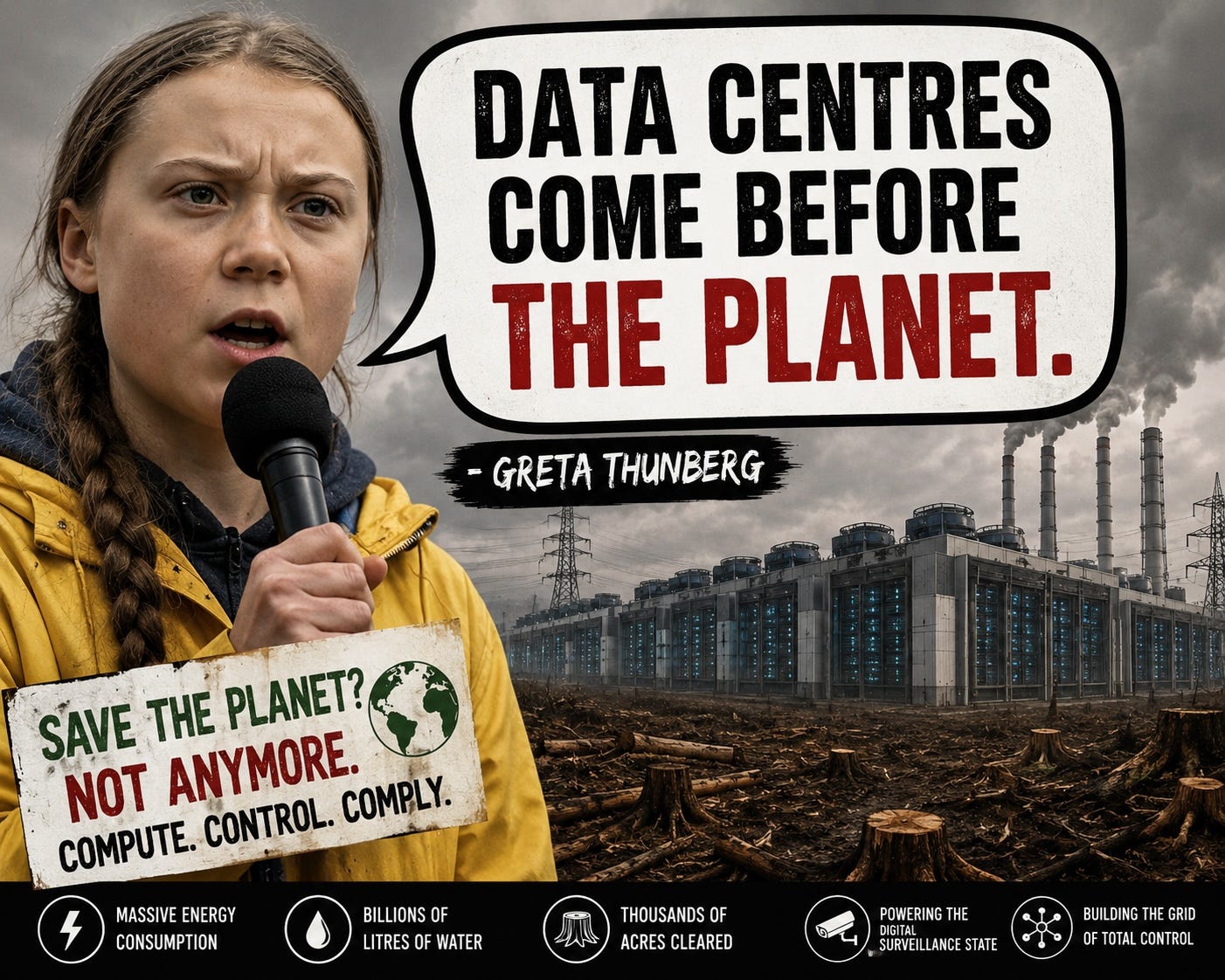
Apparently your gas stove threatens the planet.
Your pickup truck threatens the planet.
Your meat consumption threatens the planet.
But gigantic AI campuses consuming the electricity of small cities?
Those are now called “innovation.”
What changed?
The Realization That Changed Everything
The more I began researching AI data centres, the more I realized:
The data centre is not the product.
The data centre is the foundation.
Everything now being discussed under the banner of “digital transformation” depends on enormous computing power.
Artificial Intelligence.
Digital identity.
Smart cities.
Digital currencies.
Automation.
Surveillance systems.
Predictive systems.
Agentic AI.
Cloud governance.
Biodigital systems.
None of it functions at scale without infrastructure.
And that infrastructure is now being built at breathtaking speed.
These Are Not Your Grandfather’s Data Centres
When most people hear the term “data centre,” they picture a building that stores family photos, emails, websites, and online backups.
That’s what data centres largely did for the last twenty years. But the facilities now being proposed across Alberta and around the world are different.
These are AI data centres.
Their primary purpose is not storing your vacation photos. Their purpose is processing information. Massive amounts of information.
Think of it this way:
The old data centre was a filing cabinet.
The new AI data centre is a factory.
Instead of storing information, it continuously analyzes, predicts, models, automates, and generates information. (I just found the highlighter…look out I have a thing for highlighters)
These facilities are designed to power:
Artificial Intelligence
AI agents
Enterprise automation
Predictive systems
Autonomous systems
Real-time analytics
Digital infrastructure
Machine learning
That is why they require so much electricity. That is why they require so much water. That is why governments and investors are planning them at unprecedented scale.
You don’t need gigawatts of power to store family photographs. You need gigawatts of power when millions of AI systems are processing information around the clock.
The public is still imagining a giant Dropbox.
The investors are building the computational backbone of the next digital economy.
That distinction matters.
A lot.
Nadia Partners: Connecting the Dots
One firm that recently caught my attention is Nadia Partners.
Most people have never heard of them. But their portfolio tells a story that should concern every person who can fog a mirror.
They are not simply investing in AI software.
They are investing across the entire AI ecosystem.
Beacon Data Centers
Beacon is developing more than 10 AI-focused data-centre campuses representing over 6 GW of planned development.
This is industrial-scale infrastructure.
Not a startup. Not an app. Not a chatbot. Infrastructure.
Dromore Energy
An Alberta-focused energy company building solar and battery-storage systems designed to support grid stability.
AI One
A company that connects fragmented enterprise systems and allows AI agents to operate across organizational databases and workflows.
Huper
A company promoting “human-agent collaboration.”
Its own website states: “The future belongs to superhuman leaders.”
The company envisions hybrid teams made up of humans and AI agents… please read that line a few times.
Lockchain
AI-powered cybersecurity and blockchain monitoring.
When viewed separately, each company appears harmless.
When viewed together, a larger picture emerges.
Data centres.
Power systems.
Enterprise integration.
AI agents.
Cybersecurity.
Automation.
Not isolated technologies.
An ecosystem.
Agenda 2030 and the Digital Future
For years, many people warned that Agenda 21 and later Agenda 2030 were about much more than environmental protection.
They were mocked.
But now we can clearly see that many of the systems promoted under the Sustainable Development Goals depend upon exactly the kind of infrastructure now being built.
The UN speaks of:
Digital inclusion
Legal identity for all
Smart cities
Climate monitoring
Data-driven governance
Public-private partnerships
Integrated digital systems
Individually, each objective sounds reasonable.
Collectively, they require continuous collection, storage, analysis, and management of massive amounts of human data.
That requires compute. Massive compute.
The AI data centres being proposed across Alberta and around the world provide exactly that capability.
Biodigital Convergence
Then there is the term “biodigital convergence.” This is not conspiracy theory language. It appeared in a Government of Canada Policy Horizons paper exploring the merging of biological and digital systems.
Read that again carefully. Biological and digital systems.
At the same time corporations are openly discussing:
Human-agent collaboration
AI-assisted management
Digital identity
Behavioral systems
Predictive analytics
Automated workflows
Are we merely building better tools?
Or are we slowly redefining what it means to be human?
The Environmental Contradiction Nobody Wants to Discuss
For decades the public was conditioned to believe humanity itself was the threat.
Too many people.
Too much consumption.
Too much freedom.
Too much mobility.
Too much ownership.
Figures like Dennis Meadows and Maurice Strong promoted visions of global management tied to sustainability and resource control.
Now, despite decades of climate fear messaging, fossil fuels are suddenly acceptable when required to power AI infrastructure.
Why?
Because the priorities changed. The goal is no longer simply environmentalism.
The goal appears to be digitization.
Total digitization.
And digitization requires infrastructure.
Alberta: May Be Ground Zero For Canada But Make No Mistake It Is Coming To a Town Near You…
This is not just happening in Silicon Valley. It is happening here in Alberta.
Our government is aggressively pursuing:
AI data centres
Carbon capture
Smart-grid infrastructure
AI development
Digital systems
Massive energy expansion
The public is being told this is economic development.
But economic development for whom?
Who owns these systems?
Who controls the data?
Who benefits from the automation?
Who governs the algorithms?
What happens when every aspect of daily life becomes dependent on interconnected digital systems that ordinary citizens neither understand nor control?
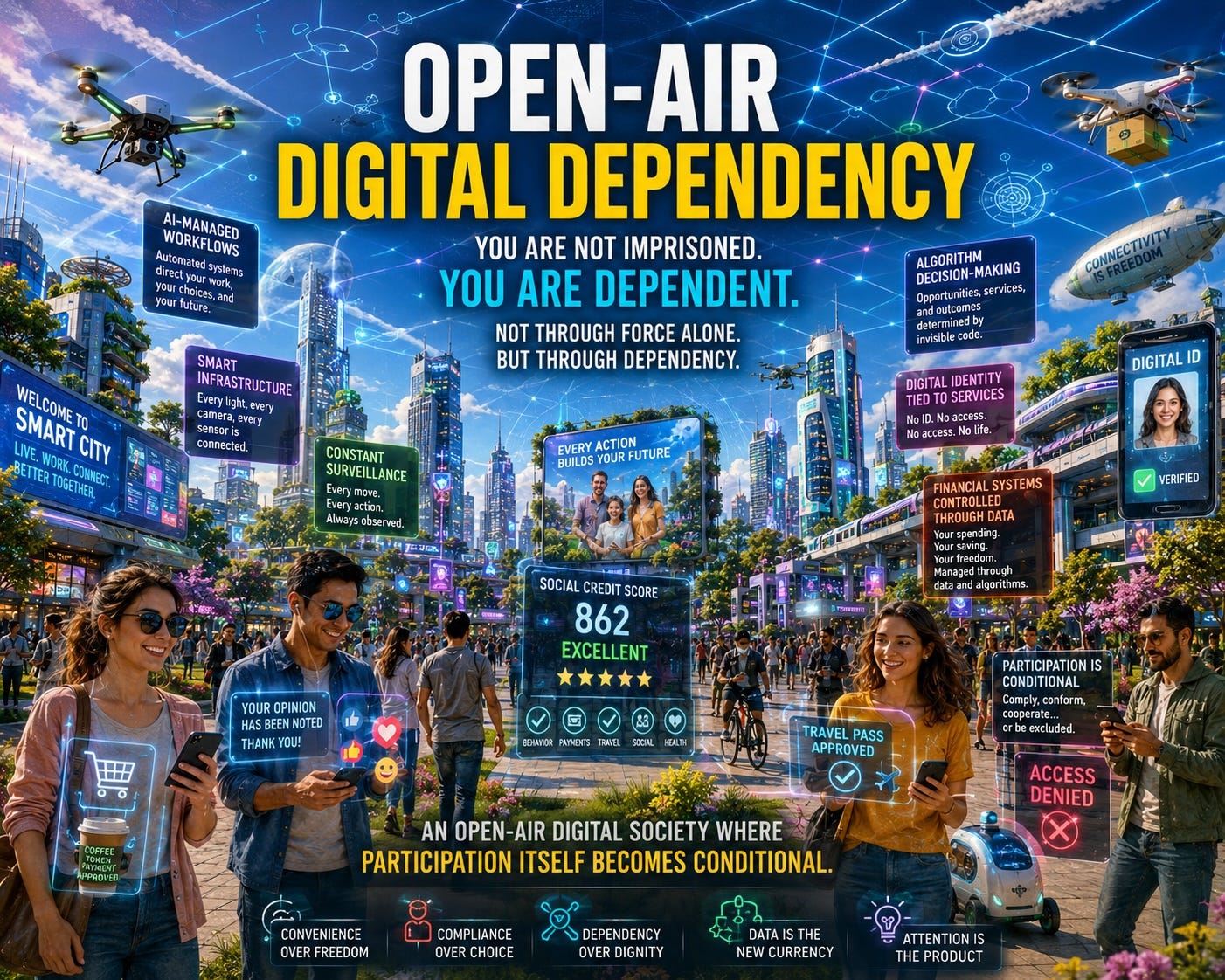
Open-Air Digital Dependency
People often imagine tyranny as barbed wire and prison walls.
But what if modern control looks different?
What if it looks like:
Digital dependence
Automated systems
AI-managed workflows
Smart infrastructure
Constant surveillance
Algorithmic decision-making
Digital identity tied to services
Financial systems controlled through data
An open-air digital society where participation itself becomes conditional.
Not through force alone. But through dependency.
The Most Important Question
This article is not anti-technology. Technology itself is neutral.
The question is:
Who controls it?
Because once the infrastructure is built:
The data centres remain.
The databases remain.
The surveillance capability remains.
The AI systems remain.
Governments may change.
Corporations may change.
The capabilities remain.
Connect the Dots
Maybe this buildout leads to incredible innovation and prosperity.
Or maybe we are watching the construction of the most sophisticated system of centralized management humanity has ever seen.
Either way, one thing is certain:
The infrastructure is already being built.
The concrete is already being poured.
The transmission lines are already being approved.
The AI systems are already being integrated.
The question is whether enough people are paying attention before the system becomes too large to resist.
Connect the dots.
Ask questions.
Stay informed.
Take action.

Click the Image Above and Join Today, Invite Your friends, Share Share Share
Although I love the idea of creating a group or many groups for that matter, but why would you be creating a group and putting it on Facebook? Of all the censored, shadow banned, co-opted social media platforms out there, you couldn’t think of a better option? Aim for a platform that has at least a modicum of privacy! Maybe Telegram, Discord or Quora. We need to stop being patrons of the biggest technocratic offenders, to our sovereignty!
The right question is what entity controls the AI data centers?
In similar fashion, what entity is facilitating chem trailing the planet?
The answer to those questions will prove troubling.