
Regulatory Capture 301: From Enforcement to Exemption: The New Administrative State
While You’re Watching the Headlines, They’re Rewriting the Rules

The Point of No Return: How C-9 and C-15 Redefine the Rule of Law in Canada
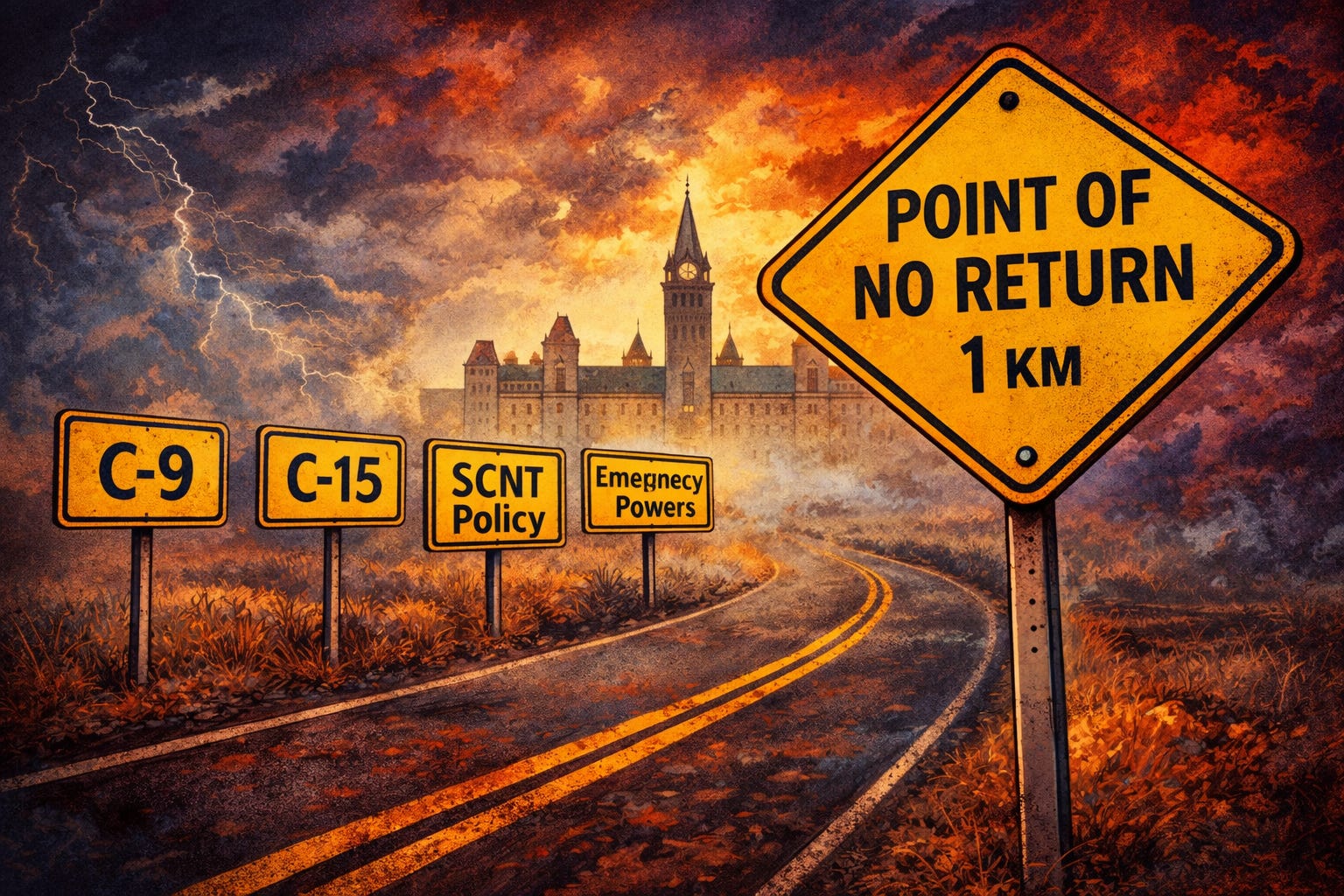
Regulatory Capture 301
Regulatory capture is not cartoon corruption.
It is when:
Decision-making migrates from Parliament to administrative systems.
Enforcement becomes flexible.
Exemptions become negotiable.
Accountability becomes opaque.
Bill C-9 strengthens the enforcement infrastructure.
Bill C-15 strengthens the exemption infrastructure.
That is not theoretical tyranny. It is structural concentration of authority inside the executive-administrative state.
The same administrative state that:
Invoked the Emergencies Act unlawfully (as ruled by Federal Court)
Continues to resist acknowledging that ruling
Expands regulatory tools rather than narrowing them
This is how governance shifts. Not through dramatic coups. Through layered discretion.
Why This Matters Now
When enforcement tools expand, citizens feel the pressure. When exemption tools expand, insiders feel the relief. If both expand simultaneously, the system becomes less about law, and more about who has access.
That is the danger point.
Not “authoritarianism.” Not “dictatorship.”
But unequal application of law.
History shows that once discretion replaces uniform rule, trust collapses. And when trust collapses, compliance becomes fear-based rather than consent-based. That is not a stable democracy.
The Question Canadians Must Ask…
Do we want:
A country where laws are debated openly and applied equally?
OR
A country where enforcement expands while exemptions are quietly granted behind closed doors?
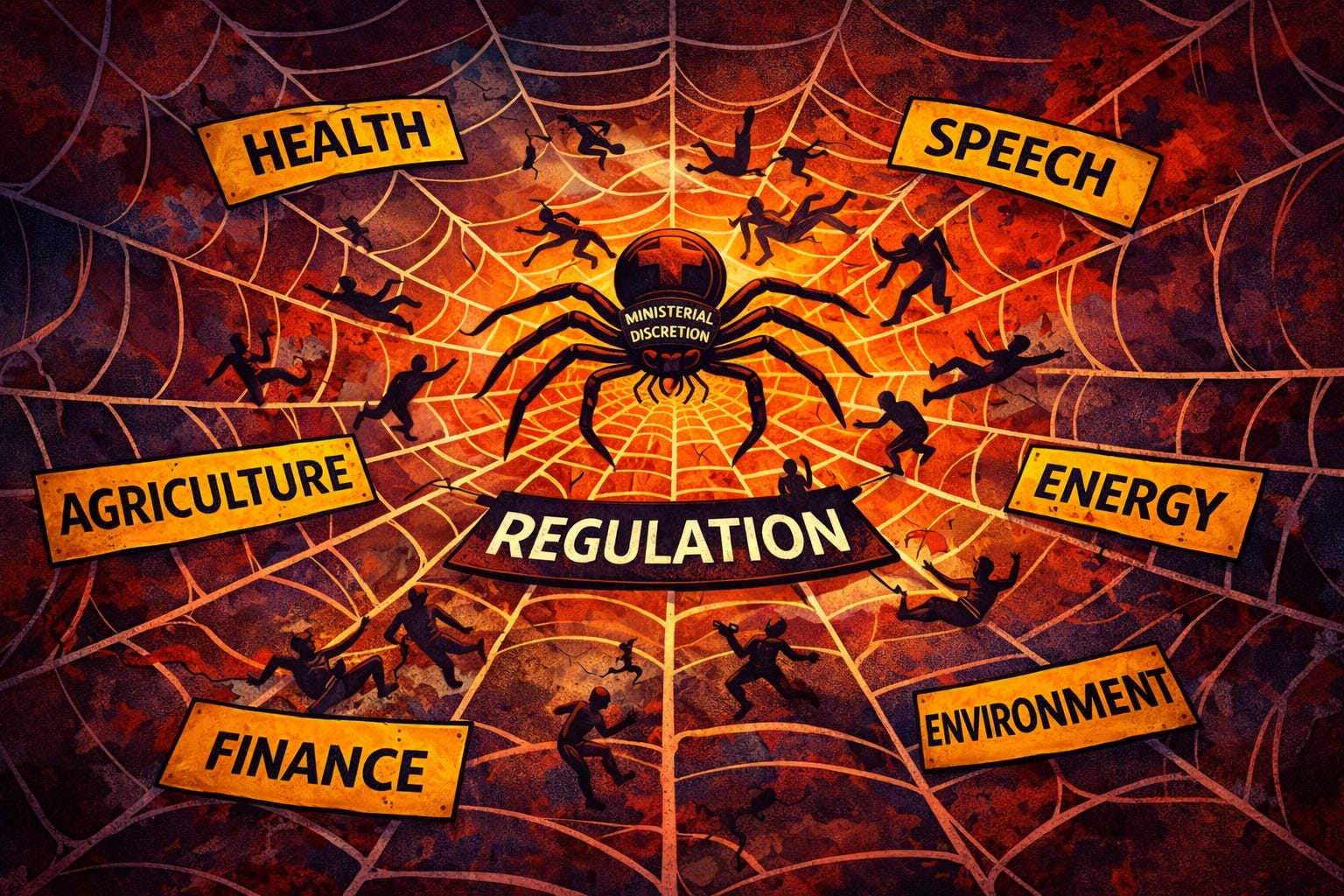
Bill C-9 and Bill C-15 may be presented as unrelated.
They are not.
One builds enforcement reach. The other builds exemption power. Together, they shift authority further away from Parliament and further into executive discretion.
That is Regulatory Capture 301.
This is not about left versus right. It is about structural power.
The rule of law does not collapse in one dramatic moment.
It erodes when:
Enforcement grows
Transparency shrinks
Exemptions multiply
And the public is too distracted to notice
The machinery is being built. The question is whether Canadians are watching.
Because once enforcement and exemption are fully embedded in administrative hands…
There is no turning back.
So let’s take a closer look… at C-9 and C-15 and what they do not want you to see…
The Forfeiture Clause: The Quiet Expansion
Most people skim past forfeiture provisions. They shouldn’t. Under Bill C-9, if a person is convicted of certain hate-related offences, the court may order forfeiture of:
“anything by means of or in relation to which the offence was committed”
That language matters.
“Anything.”
“By means of.”
“In relation to.”
Forfeiture provisions traditionally target property directly used to commit an offence, for example, equipment used in fraud, or illegal materials in trafficking cases.
But Bill C-9 does not clearly define the outer boundary of “anything.” It does not explicitly restrict forfeiture to tangible property. It does not require the property to be directly and primarily instrumental. It does not expressly protect expressive tools, devices, platforms, materials, that may be part of ordinary participation in public life.
And importantly:
It adds forfeiture “in addition to any other punishment imposed.” That means seizure can accompany imprisonment, fines, probation, bail conditions … layered penalties.
Now place that beside the fact that Bill C-9 also:
Lowers procedural barriers to laying certain hate-related charges
Expands police charge-laying authority
Increases investigative tools
The result is not hypothetical tyranny. It is expanded leverage.
Because forfeiture does not just punish. It pressures. It chills. It signals to citizens that speech-adjacent conduct may carry material consequences beyond conviction. Even if courts later narrow interpretation, the process itself becomes the punishment:
Arrest
Seizure
Legal costs
Frozen accounts
Reputational damage
When definitions broaden and forfeiture language remains elastic, enforcement risk expands. And when enforcement risk expands, expression contracts.
That is how power reshapes behavior without ever formally banning it.
How This Interacts With Bill C-15
Now step back.
Bill C-9 strengthens enforcement tools, including forfeiture.
Bill C-15 expands ministerial power to exempt selected entities from federal laws (other than the Criminal Code) for up to six years. So we now have:
Broader criminal enforcement for citizens
Broader regulatory exemption for executive discretion
That asymmetry is the issue.
If enforcement grows for the public while flexibility grows for insiders, the principle of equal application of law weakens.
Rule of law depends on predictability.
Discretion layered on discretion produces something else.
This Is Not New. That’s What Makes It Dangerous.
History shows that republics do not collapse in dramatic fashion. They evolve.
In late Republican Rome, emergency powers granted “for the public good” became normalized. The Senate still met. Laws still passed. But executive discretion quietly expanded until the structure of the Republic remained, while its balance did not.
In the 20th century, Western democracies built vast administrative states in response to war and economic crisis. Parliament legislated broadly. Agencies interpreted. Ministers exercised discretion. Each expansion was justified. Each exception seemed necessary.
Over time, enforcement hardened downward, and flexibility concentrated upward. That asymmetry is the turning point.
The pattern repeats:
Crisis expands authority.
Authority rarely contracts.
Discretion accumulates.
Bill C-9 expands enforcement.
Bill C-15 expands exemption.
Separately, each can be defended.
Together, they alter the structure of accountability.
History does not warn us with explosions. It warns us with patterns. This is not the time for outrage posts. It is the time for clarity.
If Bill C-9 expands punishment
and Bill C-15 expands executive exemption power, then the structure of law in Canada changes.
Not symbolically. Structurally.
This is not about “monitoring the situation.”
It is not about “hoping amendments fix it.”
It is not about waiting for courts to clean up what Parliament enables.
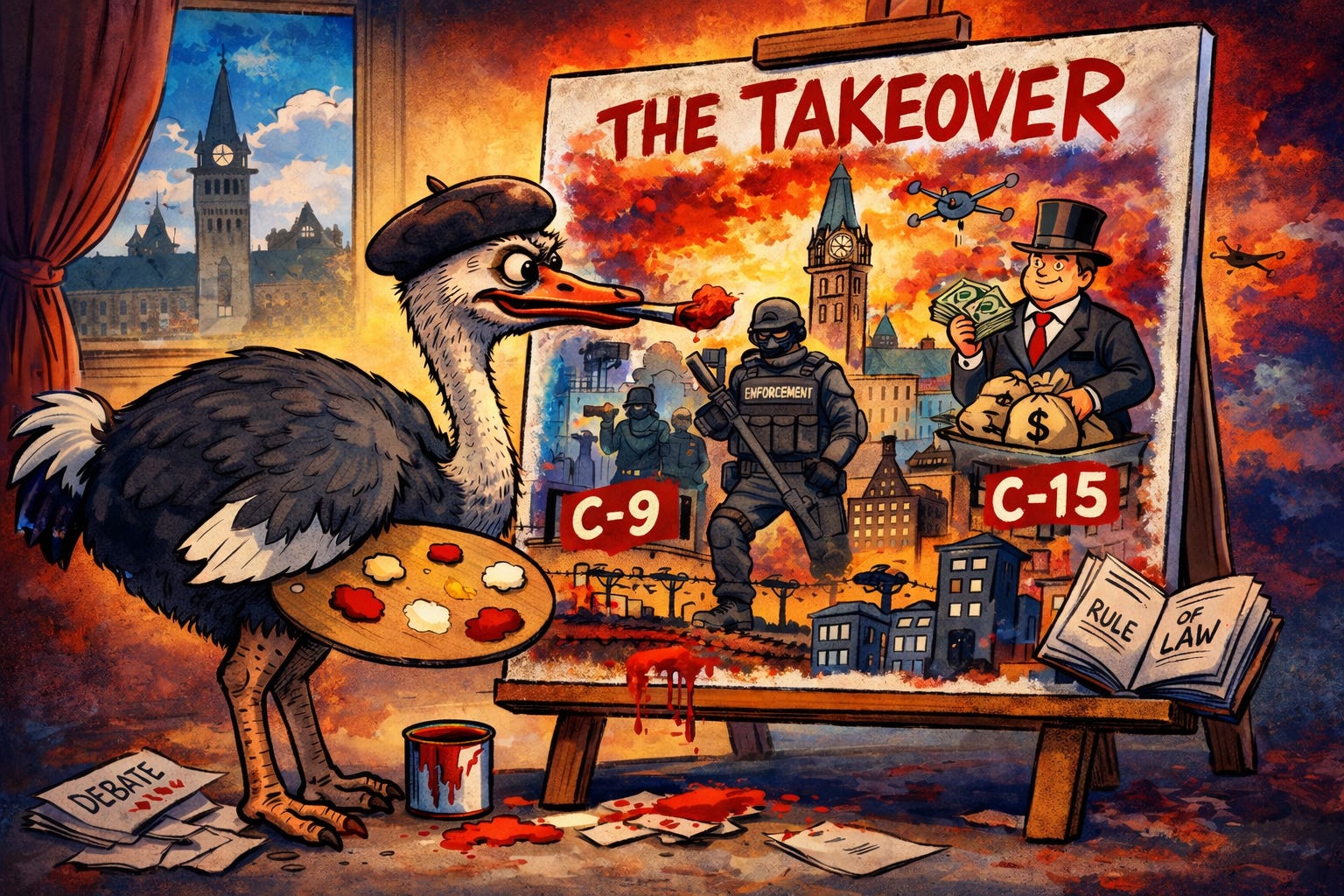
These bills must be stopped.
Not softened.
Not tweaked.
Not massaged with clarifying language.
Stopped.
Because once executive exemption authority exists, it will be used.
Once forfeiture language is embedded, it will be expanded.
Once enforcement thresholds are lowered, they will not rise again.
History does not reverse asymmetry.
It normalizes it.
What That Means Practically
Flood MPs and Senators, not once, repeatedly.
Bill C-9 should be withdrawn in full.
We already have criminal law to address violence and real threats.
Bill C-15’s Section 12 exemption authority should be removed in full.
Ministers should not be able to suspend federal laws by executive order.
Omnibus bills should not be vehicles for structural governance changes.
Full stop.
No amendments.
No softening.
No “let’s fix the wording.”
Withdraw. Reassess. Debate openly.
The erosion of equal law does not begin with dramatic collapse. It begins when citizens stop insisting on boundaries.
And boundaries only hold when people enforce them.
Do not wait for a party to save you.
Do not wait for courts to rescue you.
Do not assume “someone else” is handling it.
Once enforcement expands and exemption expands simultaneously, power no longer flows from Parliament outward. It flows inward … toward executive discretion.
And that is the point of no return.
If you care about democracy, don’t scream.
Don’t retreat.
Engage.
Write and call your MP.
This Is the Line
The Reality
Governments test the perimeter. If there is no resistance, they advance. If there is resistance, they retreat.
That is not theory.
That is political physics.
These bills are not inevitable.
They move only if the public allows them to move.
Shut them down.
Not because you are radical.
But because the rule of law depends on equal application, not selective exemption and expanded seizure power.
This is the moment to prove that Canadians still understand the difference.
I love the graphic, Connie! The only sign missing is the "Civil War .5 KM" We have many centuries of experience to show them that they are on the path to civil war. Where the government deludes itself is in thinking that their police forces and military will follow orders. They won't. They are among us. They are us. They shop with us and they feel the pain. They will side with the majority once the SHTF. MPs will need to flee the country or hide in bunkers unless they change.
Connie, Your points are well taken; unfortunately, we are probably already past the point of no return. Regardless of whether those bills make it through successfully, Canada is on such a steep, slippery socialist/Marxist/communist slope that even if they don't the outcome will likely be eventually the same. Unfortunately, efforts such as yours (and those of others like you), to sound the alarm, have been mostly in vain as the vast majority after all these years are still hopelessly ignorant of what is actually happening nationally and geopolitically. Recently, I discovered that over 50% of Canadians still put trust in the government and in mainstream media—that stat should speak for itself.