
From Shared Sovereignty to Managed Reality: How Five Canadian Leaders Walked Us Into the Same Global System
Different parties. Different styles. Same direction.

There’s a difference between information and understanding.
Most of what shapes our lives happens quietly, long before it reaches a headline.
This isn’t about left versus right.
It’s about patterns.
Let’s take a closer look.
The idea that Canada’s global trajectory swings back and forth with elections is comforting, until we realize it is FALSE. When you line up the words of our leaders over the last few decades, a single pattern emerges: sovereignty redefined, step by step, until it becomes something managed rather than held.
The clearest proof came at Davos 2026, when Mark Carney said something previous leaders carefully avoided: (CLICK IMAGE BELOW FOR FULL SPEECH)

“The rules-based international order was partially false… We participated in rituals we privately knew were not true.”
That wasn’t a slip, it was a culmination.
To understand how we got here, look at what came before … in their own words.
Pierre Trudeau: Undermining Sovereignty Before It Was “Shared” (Liberal)
Before Canadians were told they would need to give up some sovereignty, they were first taught to distrust the very idea of it.
That shift begins with Pierre Elliott Trudeau.
Pierre Trudeau did not argue for global governance directly.
He did something more foundational and more lasting.
He reframed where sovereignty lives.
Trudeau viewed nationalism, even democratic nationalism, as a threat to individual liberty. In its place, he advanced a model where authority flowed not primarily from the collective will of citizens, but from centralized principles enforced by courts and experts.
This transformation was crystallized with the Charter of Rights and Freedoms.
With the Charter, sovereignty subtly shifted:
from Parliament to the judiciary
from elected representatives to legal interpretation
from democratic consent to managed rights
This was not merely a legal change, it was a philosophical one.
Canada moved away from being a nation governed by the will of its people and toward a system governed by abstract principles administered from above. Once sovereignty is no longer grounded in the people themselves, it becomes transferable … first domestically, then internationally.
Pierre Trudeau did not say Canada should surrender sovereignty to global institutions.
He made it conceptually acceptable to weaken it at home.
That distinction matters. Because once sovereignty is no longer rooted in the people, the question is no longer whether it can be shared … only how much and with whom.
Paul Martin would later say the quiet part out loud.
Paul Martin: Saying the Quiet Part Out Loud (Liberal)
The earliest and most explicit statement in this progression came not from Davos, but from Paul Martin himself. (CLICK IMAGE BELOW FOR FULL SPEECH)

Speaking on CPAC on February 10, 2009, in the context of the G20 and global financial governance, Martin stated:
“Unless we’re prepared to understand that in fact we’re all going to have to give up a little bit of our sovereignty in order to make the world work.”
He did not hedge.
He did not qualify the statement as temporary.
He did not frame it as hypothetical.
Martin went on to argue that the post-1944 Bretton Woods system, built around independent nation states cooperating while largely ignoring internal governance, was no longer sufficient for a globalized world.
“That day is over… countries have responsibilities to their neighbors, and their neighbors are in every nook and cranny of the world.”
This was not an off-hand remark.
It was a foundational declaration.
Sovereignty, in Martin’s framework, was no longer a democratic absolute.
It was an obstacle to be managed, shared, and superseded in the name of global stability.
This was what I see as Phase One, not imposed by force, but presented as inevitable.
Everything that followed rests on this premise.
Stephen Harper: Defending the Architecture (Conservative)
Stephen Harper is often remembered as a nationalist counterweight. His words tell a different story.
At the World Economic Forum, Harper said:
“Canada is a strong supporter of the rules-based international order, which has brought stability, prosperity, and security to the world.”
STOP there and go back up to what Carney said just a few hours ago…“The rules-based international order was partially false… We participated in rituals we privately knew were not true.” Are you picking up on these WORDS?
And later:
We must strengthen global institutions and work with our allies to uphold shared democratic values.”
Harper never questioned the system itself.
He protected it.
What changed under Harper was tone, not structure:
Sovereignty was defended rhetorically
But pooled operationally
Through alliances, treaties, and enforcement mechanisms
This was Phase Two: alignment.
Justin Trudeau: Bringing Global Governance Home (Liberal)
With Justin Trudeau, global governance stopped being abstract.
At the UN, Trudeau stated plainly:
“Canada understands that national borders are no longer sufficient to address the challenges we face.”
At Davos:
“The world expects Canada to lead … on climate, on inclusion, on sustainability.”
And most revealing:
“Governments alone cannot do this. We need a whole-of-society approach.”
This marked a critical shift.
Global goals were no longer implemented between states …
They were implemented through society:
Cities
Schools
Health systems
Corporations
Citizens themselves
This was Phase Three: internalization.
Mark Carney: Ending the Pretence (Technocratic)
At Davos 2026, Carney removed the mask.
“We are not in a transition. We are in a rupture.”
He admitted what others danced around:
“The strongest exempted themselves when convenient. Trade rules were enforced asymmetrically.”
And then came the line that reframes everything:
“This is not sovereignty. It is the performance of sovereignty while accepting subordination.”
In Carney’s framework:
Sovereignty is no longer legal authority
It is resilience
Capacity
Ability to withstand pressure
This is not democratic sovereignty.
It is risk-managed sovereignty … borrowed from finance, not constitutional law.
This is Phase Four: management.
The Continuity, Made Visible
Put their words side by side:
Martin: “We must share sovereignty.”
Harper: “We must defend the rules-based order.”
Trudeau: “Borders are no longer sufficient.”
Carney: “The order was a fiction.”
Each statement contradicts the last, yet each depends on it.
This is not ideological drift, it is planned evolution.
Why Carney’s “Honesty” Is the Most Dangerous Shift
Carney invoked Václav Havel’s warning about “living within the lie.”
But here is the uncomfortable inversion:
The lie was not removed.
It was updated.
The old promise:
Rules will protect you.
The new promise:
Capacity will protect you.
In both cases, citizens are not the sovereign unit.
The Question That Remains
If sovereignty is now defined as:
State capacity
Regulatory resilience
Coalition alignment
Then what role is left for democratic consent?
Because when voting no longer alters direction, only speed, Democracy becomes ritual.
And that, historically, is how systems persist even after belief disappears.
Carney says we’ve taken the sign out of the window.
But if the sign is gone, and the system remains …
Who exactly is this honesty for?
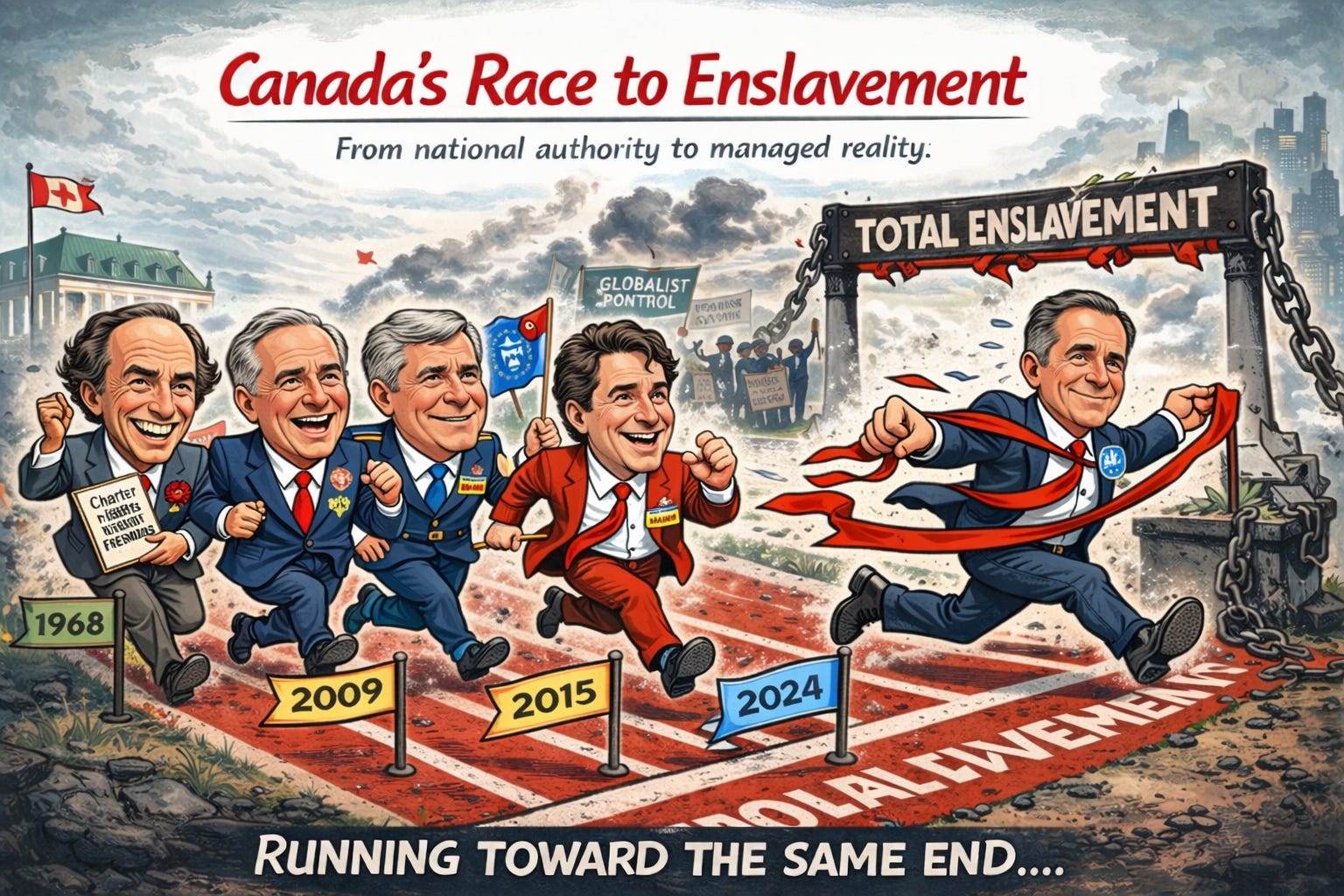
Different leaders.
Same direction.
Same finish line.
This isn’t satire … it’s a warning.
If you don’t consent to where this is heading, learn how to push back … lawfully, intelligently, and together. Click the Image below

From Oz: all traitors to Canada and its people. Same here and in NZ.
Thank you, Connie: This isn’t about left versus right. It’s about PATTERNS" Thank you for your understanding this, showing this, and expressing it so very clearly..